PART 15: LOCAL GOVERNMENT
15.1 INTRODUCTION
The first European settlement of Western Australia
was established on 26 December 1826 by Major Edmund Lockyer at King George III Sound - the location of the present-day city
of Albany - on
behalf of the New South Wales colonial
government.
The NSW convict-supported military garrison settlement
was founded in response to British concerns about the possibility of a French
colony being established on the coast of Western Australia.
Western Australia was formally annexed on 21 January
1827 by Lockyer when he commanded the Union Jack be raised and a feu de joie fired by the troops. In so doing he thoughtfully
took the time to formally take possession of the western third of the entire
Australian continent for the British Crown.
In June 1829 the Swan River Colony was established on the Swan River by
Captain James Stirling,
who was the colony's first Lieutenant (military) Governor.
By 1832, the British settler population of the colony
had reached around 1,500, and the official name of the colony was changed to
Western Australia. The two separate townsites of the colony developed slowly
into the port city of Fremantle and the state's capital
city, Perth.
On 7 March 1831 the King George III Sound
colony was transferred to the control of the Swan River Colony, and
given its current name of Albany in
1832.
From 1850, an influx of convicts boosted the size of
the colony and their labour helped shape the early architecture of the city.
York was the
first inland settlement in Western Australia, situated 97 kilometres east of
Perth and settled on 16 September 1831. York was the staging point for early
explorers who discovered the rich gold reserves of Kalgoorlie.
Western Australia achieved responsible government
in 1890, and federated
with the other British colonies in Australia in 1901
While the various colonies in Australia were either
sparsely populated or penal settlements or both, executive power was in the
hands of the Governors, who, because of the great distance from their superiors
in London and the resulting very slow communication, necessarily exercised vast
powers. However, the early colonists, coming mostly from the United Kingdom,
were familiar with the Westminster system and made efforts
to reform it to increase the opportunity for ordinary men to participate.
The Governors and London therefore set in motion a
gradual process of establishing a Westminster system in the colonies, not so
fast as to get ahead of population or economic growth, nor so slow as to
provoke clamouring for revolutionary change as happened in America. Initially,
this took the form of appointed or partially elected Legislative Councils.
Then, during the 1850s, all Australian colonies except Western Australia, along
with New Zealand, established both representative and responsible government;
Western Australia did the same in 1890. (Source:
Wikipedia)
It must be remembered that in
the early 1800's, England was recovering from its ill-fated War of Independence with the Americas (1775–1783)
England had also gained
valuable experience with free settlers and freed convicts from its New South Wales
colony, so the Crown endeavoured to create a society that would work, with
remote power and control executed from London.
The New South Wales experience had taught some valuable
lessons in military governance of free settlers. By the time Captain Stirling
became the first Lieutenant Governor, New South Wales had had seven individuals
serving in that office – some of whom had troubling experiences with the free
settlers.
Victoria and Tasmania were first settled in 1803, so there was much
accumulated official experience adapting to the new nation.
England discovered its
military governors were not deities ruling a subservient and compliant
populace, so political adjustment evolved.
Western Australia
was such as vast territory that the then time delays in communications and
travel required a local presence for government across the landscape.
Hence the Western Australia
settlements were constituted under a new political and social order – to be
seen in the various successive Acts shown below, establishing what was
eventually to become "local government".
The concept of "local
government" became a necessity for effective central governance and
political control.
However the experiment
required considerable adjustment, as can be seen in the evolution of new
conceptual systems as time progressed and the population increased.
Parliament was honest in those
times, as shown by the text of the City of Perth Improvement Ordinance 1858, which states in
part:-
"Whereas
the general System for the Management and Improvement of Towns in Western
Australia as by Law heretofore established has been found to be inefficient and
unsuited to existing Circumstances in the City of Perth, and it has been deemed
expedient that the existing Law upon the Subject, so far as it relates to the
said City, should be altered ………………………………"
Openness and Transparency were
alive and well in those times.
15.2 WHAT
IS LOCAL GOVERNMENT ?
The term "local
government" is a misnomer, being a political device designed to convince
citizens that somehow the government in their area of residence is aligned with
their hopes and aspirations.
Citizens have been taught that
their elected local representatives earnestly present their views, requests,
recommendations, advice, suggestions and complaints to their local Council, who
is commissioned by statute to make decisions on their behalf - in the public
interest and for the publick goode.
Local governments are granted very
wide powers spanning a very wide range of social activities – all of which
affect the lives of every man, woman and child under their jurisdiction.
Despite these conditions,
local governments are restricted in their scope by terms set down from time to
time by the Western Australia Parliament in various Acts and subsidiary
legislation.
On the other hand, the terms
of reference for local governments do not require them to listen to their
constituents, so even where a local government does have jurisdiction and power
it may not act according to the expressed wishes of its electors.
If it is a misnomer then what
is "local government" ?
Local
Government as we know it in Western Australia began in 1841 with the
Legislative Council passing Western Australia Act Number 4 of Queen Victoria:–
No. 4 –
12 March 1841
JOHN
HUTT, GOVERNOR AND. COMMANDER-IN-CHIEF
23
September 1841
No. II.
(2) – 27 June 1844
No. X -
05 August 1847
No. 15 –
Assented to 4th December, 1850
An Ordinance to provide for the Improvement of Towns in Western
Australia
No. X -
Assented 28 October 1858
City of Perth Improvement Ordinance 1858
No. 6 –
02 January 1871
The Municipal Institutions Act 1871
District Roads Act 1871 Amendment Act 1876 (40 Vict.
No. 12)
The Municipal Institutions Act 1876 Amendment Act (42 Vict. No. 16)
The Municipal Institutions Further Amendment Act (44 Vict. No. 11) 08
September 1880
The Municipal Institutions Further Amendment Act (45 Vict. No. 12) 16
September 1881
The Municipal Institutions Further Amendment Act (46 Vict. No. 19) 21 September 1882
The Municipal Councils Titles Act 1885 (49 Vict. No. 14)18 September
1885
The Municipal Institutions Act 1876 Amendment Act (49 Vict. No. 17)24
September 1885
The Municipal Footpaths Act 1888 (51 Vict. No. 29)- 19 April 1888
The Municipal Institutions Act Amendment Act 1892 (55 Vict. No. 16)- 18
March 1892
The Municipal Institutions Act 1895 (59 Vict. No. 10)
This 1895 Act is the Act which established local
governments as we know them today.
It repealed all of the above Acts and replaced them
with a new and detailed system for local government.
What then is "local
government" ?
The answer is to found in the
Western Australia Constitution Act 1899.
This Act focuses on the
continuation of the then existing Legislative Council and the creation of the
Legislative Assembly
The Parliament's powers are
neither defined nor limited.
As can be seen above, the governance
of towns was originally granted to and by the citizens of each town, but in
1871 the concept of elected town Councils was developed.
The Western Australia
Constitution Act 1899 appears to accept the status-quo of the substantial
existing laws then in place in the Colony.
15.3 ORGANISATIONAL STRUCTURE
The current statutory structure of local government organisations in
Western Australia is set down in the Local Government Act 1995 and is that of
the traditional “pyramid” structure – i.e. “top down”.
Power, control and discretional authority is inversely proportional to
the level on the pyramid.
However, unlike the private enterprise system whereby the Board of
Directors is wholly in control of the organisation with its Chief Executive Officer
being a servant subject to its direction, in the case of local government the
CEO is actually in charge and the Council merely a board of review.
In fact the Local Government Act allows the Council to abrogate some of
its review and approval functions directly to the CEO, allowing the Council not
to be bothered with those functions.
The current system of Local Government is a
continuation of the 19th century autocratic EXECUTIVE governance system
established by the colonial governors of England from 1788.
The only real practical difference is that the Mayor and elected Council
of self-nominated citizens replaces the Office of Governor and his Executive
Council - but does not represent the Crown.
It is NOT the system of self-government available to
citizens throughout the 1800's as described in the set of laws referenced
above.
If that claim sounds hard to believe, see for yourself the evidence at
https://www.youtube.com/watch?v=aFRUU2jTmEw
The current situation demonstrates "the Rule of Law",
"democracy" and "freedom of speech" at local
government level have actually regressed since 1788.
Given Councillors are ordinary citizens having no
special training or attributes, are part-time officials, often bear prejudiced
attitudes and/or pursue personal agendas, may be foreign born and bred or have
foreign affiliations or allegiences, and are not required to reveal their
political affiliations or political party memberships, it is abhorrent to a
free and open society that such persons should be given discretion to exercise
unconstrained powers directly upon fellow citizens without any semblance of
scrutiny or accountability.
It is relevant that
the Oath of Allegiance to HM Queen of Australia to be made by Councillors as
a condition of office, was abolished by the WA Lieutenant-Governor and
Administrator in Executive Council by the simple device of changing the relevant Form.
Details are published in the Local Government (Constitution) Amendment
Regulations 2006 and gazetted 20
January 2006 at page 380.
The Oath of Allegiance to the Queen was removed by Parliament by
amending Section 2.29 of the Local
Government Act 1995 (amended by No. 24 of 2005 s. 57)
This leaves Councillors free to give allegiance to their own cause.
They claim to represent the Crown but do not give allegiance to it.
Welcome to your local DEMOCRATICALLY ELECTED AUTOCRATIC REPUBLIC.
15.4
LEGITIMACY, POWERS, SCOPE AND FUNCTION
Andrew Hastie MHR,
Federal Member for the Australian Parliament electorate of "Canning"
which includes the City of Armadale local government district, describes local
government as such:
"Your
local government's role is to oversee the facilities and services available in
your neighbourhood. Issues you can
contact your local councillor about are: parks and recreational facilities, pet
ownership, rates, maintenance and rubbish collection."
Source: http://www.andrewhastie.com.au/local-government June 2016
WHOOPYDOO
!!!!
That may be a populist perception for dumbed-down Electors - but is far
from complete as the following demonstrates.
The above description of local government refers only to the provision
of services.
But the active word in "local government" is
"government".
So what about "being governed" ?
What about “being subject to governance” ?
The Western Australia Local Government Act 1995 establishes local
governments and sets out their functions and powers in relation to governance
of the “local” district - i.e. over the people and activities within its
jurisdiction.
Further to that prescriptive Act of Parliament, the State of Western
Australia has also entered into an agreement with the local government industry. Why executive
government should make an agreement with itself is a mystery. Why the master should
contract with its servant is a mystery. Such is the world of politics.
Local government is given autonomy via the Local Government Act 1995.
That autonomy extends to a wide range of areas of governance limited only by
its will, creativity and financial resources.
Local government is given the power to make laws. That means the RULE OF LAW applies to laws so
made.
There are 138 local governments and shires in Western Australia. Recent
attempts by the State Government to reduce that number were defeated
politically, socially - and judicially in the Supreme Court, by an industry
determined to stake its claim to independent autonomy in the political system.
The Minister for Local Government has very limited powers of
intervention and discipline over local governments. The role of the Department
of Local Government is essentially advisory, education and training, and review
of performance.
The department has neither the resources nor will to monitor every
decision made at every meeting of every Council and every Committee – or
business conducted in unrecorded forums.
In extreme cases the Minister can dismiss a Council and instal a
Commissioner for a limited period, but that power is rarely used. However, as
has been shown around the world, even the most corrupt or inept governments can
still enjoy considerable community support of sufficient measure to prevent
their removal from office.
In practice, local governments are accountable only to their Electorate.
Electors are given opportunity to express their endorsement of existing
Councillors or to replace one or more at an election held every two years.
However each election covers only half of the Council, so if the entire
Council performs poorly it can take several elections to remove individual
Councillors - thereby entrenching the status-quo.
15.5 GOVERNANCE
Local governments have two primary streams of governance - legislative
and executive.
The SCOPE of local government's jurisdiction is defined by
Divisions 1 and 2 of the Local Government Act 1995:
3.1. General
function
(1) The general function of a local government is to provide for
the good government of persons in its district.
(2) The scope of the general function of a local government is to
be construed in the context of its other functions under this Act or any other
written law and any constraints imposed by this Act or any other written law on
the performance of its functions.
(3) A liberal approach is to be taken to the construction of the
scope of the general function of a local government.
3.2.
Relationship to State Government
The scope of the general function of a local government in relation to
its district is not limited by reason only that the Government of the State
performs or may perform functions of a like nature.
3.5.
Legislative power of local governments
(1) A local government may make local laws under this Act
prescribing all matters that are required or permitted to be prescribed by a
local law, or are necessary or convenient to be so prescribed, for it to
perform any of its functions under this Act.
Note: Local Laws CANNOT create powers beyond those
granted by the Local Government Act 1995 "to perform any of its functions
under this Act".
See also 3.18 (1) below.
That is to say in the pursuit of "good government", local
governments cannot unilaterally make up their own laws and bestow their own
powers outside the scope of jurisdiction authorised by Parliament.
Specifically, the power of local governments to make laws is limited to
"functions" performed under the authority of the Local Government Act
1995.
(3) The
power conferred on a local government by subsection (1) is in addition to any
power to make local laws conferred on it by any other Act.
3.18.
Performing executive functions
(1) A local government is to administer its local laws and may do
all other things that are necessary or convenient to be done for, or in
connection with, performing its functions under this Act.
(2) In performing its executive functions, a local government may
provide services and facilities.
(3) A local government is to satisfy itself that services and
facilities that it provides —
(a) integrate and coordinate, so far as practicable, with any provided by
the Commonwealth, the State or any
public body; and
(b) do not duplicate, to an extent that
the local government considers inappropriate, services or facilities
provided by the Commonwealth, the State or any other body or person, whether
public or private; and
(c) are managed efficiently and effectively.
3.11.
Subdivision applies to local laws made under any Act
This Subdivision applies to local laws made under this Act and the procedure for
making them and, unless a contrary intention appears in that other Act, to
local laws made under any other Act, and the procedure for making them.
3.6. Inconsistency
with written laws
A local law made under the LG Act is inoperative to the extent that it
is inconsistent with this Act or any other written law.
Note: This requirement is often ignored such that local laws may
duplicate written law, forcing an affected person to seek clarification or
redress in court (at great expense to a disaffected person).
That framework also allows local governments to choose whether to
prosecute under a local law (maximum penalty $5,000) or general laws
(prescribed penalties and/or incarceration)
3.10.
Creating offences and prescribing penalties
(1) A local law made under this Act may provide that contravention
of a provision of the local law is an offence, and may provide for the offence
to be punishable on conviction by a penalty not exceeding a fine of $5 000.
(2) If the offence is of a continuing nature, the local law may
make the person liable to a further penalty not exceeding a fine of $500 in
respect of each day or part of a day during which the offence has continued.
(3) The local law may provide for the imposition of a minimum
penalty for the offence.
Local government is
also granted powers directly by other Acts of Parliament, such as the Litter
Act 1979, which provide Councillors may personally issue litter
infringement notices on any person - including their fellow Councillors and
staff. If the Infringement Summary Conviction fine is not paid the matter
automatically becomes a criminal offence - an easy way to eliminate competing
Councillors from Council.
15.6 LOCAL GOVERNMENT IS
DESIGNED TO FAIL !!
How can this be ??
The answer lies in the statutory organisational design, which mirrors
the organisational design of an association incorporated under the Associations
Incorporation Act 1987-2015
The present situation is that the CEO manages the day to day operations
of the local government and provides advice to Council and its sub-committees.
The CEO is not required to consult Council - particularly when
exercising powers granted under Acts and Regulations other than the Local
Government Act and Regulations, or when acting under authorities delegated by
Council.
Although Council is responsible for the management of its local
government as a whole, it is unlawful for Council to direct the CEO and
subordinates to do or not do anything.
Council can only accept or reject officer recommendations on matters
presented to it by those officers.
Council may request amendments to officer recommendations but cannot
enforce them.
Council may request officers to consider an issue or matter but cannot
force them to so do.
Consequently the political structure of a council of elected officials
merely provides a publically accessible group of representatives who can talk
directly to the CEO when and if they so choose.
Theoretically that is done on behalf of Residents, Ratepayers and
Electors – or "the public", which includes facilities and services
provided by the local government to persons temporarily within their local
government district - such as teachers, doctors, workers, tradespersons,
visitors and tourists.
Note 1: Whilst physically within a local government district, the above
classes of non-residents (which may include "Electors") are subject
to the governance of the local government. Hence a tradesperson or a
courier/truck driver or taxi driver who travels around the metropolitan area
each day in the course of their work is exposed to a range of local laws –
within each local government district - to which that person must be aware of
and comply with
Note 2: If a person owns property within the district but is not
domiciled in the district, that person is an "Elector" and enjoys the
rights and privileges of that class but is also subject to town planning
schemes, usage zonings, local building standards and local laws in relation to
that property
However City of Armadale Policy and Management Practice EM8 prescribes:
"Rationale - To ensure that appropriate protocols
are maintained in communications between Councillors and Officers.
Note: Section
5.41 of the Local Government Act stipulates that the CEO is responsible for
…”management, supervision and direction…” of Council employees.
Policy
• ALL
communication to staff should (technically) be via the CEO.
For practical
reasons however, specific requests and/or queries may be communicated to the
relevant Executive Director by email or
Councillor Memo.
• The procedure
for communication between Councillors and staff shall be in accordance with
current Management Practices." (i.e. Management practice EM8)
Thus the POLICY is that ALL communications with
officers staff be via the CEO and ONLY by
email or Councillor Memo
Management Practice (Procedure) EM8 -
Communications between Councillors and Staff prescribes:
1. Written communications can be either:
• Personally handed to the Executive
Assistant to the CEO or relevant Executive Director, or
• Emailed to the CEO or relevant
Executive Director
2. The relevant Director will advise the CEO where
written communication has cross-Directorate or broader implications.
3. The officer responsible in each Directorate will
acknowledge receipt and provide a reply at the earliest but no later than 10
working days.
Note: In the event that an appropriate response cannot
be provided within ten (10) working days, an interim response is to be provided
advising the estimated time in which the required information will be
forwarded.
NOTE: Policy EM 4 “Requests for Reports by
Councillors” applies where a response provides substantial advice or a report.
(EM8 Policy and Procedure – i.e. the
above – IS the current management practice)
In other words, the official policy – determined by
Council itself – is that Councillors are not permitted to TALK to ANY staff –
AT ALL
Councillors are prohibited from criticising the work of officers or
challenging facts and figures presented in reports.
Consequently, Council is a board of review, with power to accept, reject
or refer back to officers – via the CEO - for revision.
Of note is the requirement that the EM8 PROCEDURE prescribes the officer
WILL provide a reply at the earliest but
no later than 10 working days.
("Will" and "is"
are mandatory words – i.e. the specified action MUST be performed)
Noting Council can only challenge or
query factual evidence presented to it in formal reports presented under Agenda
business items, it is obviously the case that if the staff do not want a
particular matter referenced in relevant Committee meeting report to be
challenged by all or any Councillor after said report is issued, they need only
to procedurally delay a response for a short-time to ensure it is delivered
after the relevant Council meeting.
Also, if a Committee requires
further detail on a matter before it, its options are to defer the matter –
which is not always viable or politically astute, or accept the Executive
Report as-is.
Notwithstanding Executive Officers
are present in Committee and Council meetings as MEMBERS of those Committees
but support staff for Council meetings, Local Law Standing Orders 2000 AND
Directions/Notices/Orders from the Local Government Standards Panel, ensure
that Executive Officers cannot be quizzed as to the accuracy or completeness of
any information they may provide orally – if and (only) when asked BY THE
PERSON PRESIDING
Individual Councilors are prohibited
from cross-examining Executive Officers or staff to elicit rationale, reasons
why, justifications, consequences etc.
Thus Council is shackled by its
Executive.
IMPORTANT NOTE: The claimed lawful
basis for the BAN is procedural
power. Policy and Procedure EM8 gives that same discretional power to the
Executive.
In summary, the CEO and his or her Executive Officers are the
heart of the local government – i.e. the real local government.
This principle is supported by the findings of the
Enquiry Into the City of Canning.
Source: Report of the Panel of Inquiry
Into the City of Canning
There is no lawful requirement for this group
(Executive Officers) to be accessible to or answerable to Electors, Ratepayers
or public.
Therefore if they are not accountable to the Council and not accountable
to the public then they are effectively accountable to no-one. So long as they
operate within the bounds of the laws they have created themselves to advantage
themselves and their undeclared purpose they cannot be held to account.
The risk to democratic government, freedom and the Rule of Law, is that
a local government is a "public authority" and thereby has great
powers and authorities granted directly under a myriad of Acts and Regulations.
Autocracy
and democracy do not mix.
15.6 MAJOR FUNCTIONAL PARTS OF A LOCAL
GOVERNMENT
Each Local Government entity notionally comprises fifteen major parts:
The MAYOR - acts as the public face of
the local government and can "speak" for Council or the local
government - but not bind it. Is de-facto leader and public face
of the Council and/or local government.
The mayor or president —
(a) presides at
meetings in accordance with the LG Act; and
(b)provides leadership and
guidance to the community in the district; and
(c) carries out civic
and ceremonial duties on behalf of the local government; and
(d)speaks on behalf of the local
government; and
(e) Performs such other
functions as are given to the mayor or president by the LG Act or any other
written law; and
(f) liaises with the
CEO on the local government’s affairs and the performance of its functions.
Noting "policies are NOT law and, unless
empowered by (e), has no "powers" or authorities other than those
prescribed for chairing meetings – i.e. manage meetings and maintain order.
May be elected by popular vote in a general election
or by his or her peers - i.e. fellow Councillors. The method is determined by
the incumbent Council immediately prior to an election thus, by
default, each new Council is stuck with the method chosen by its
predecessor.
In the case of Mayoral election by Council only, if
the Electors do not like an incumbent Mayor (for whatever reason) but the newly
elected Council incumbent Council does, then too bad – that's the way it is
going to be for the next two years.
The role of mayor or president is an elected public office and the
incumbent cannot be dismissed by the Council or CEO during the term of the
current council.
The DEPUTY MAYOR - performs
the functions of the mayor or president when the office of mayor or
president is vacant; or the mayor or president is not available or is unable or
unwilling to perform the functions of the mayor or president
The role of deputy mayor or deputy president is an elected public office and
the incumbent cannot be dismissed by the Council or CEO during the term of the
current council..
The COUNCIL - the designated group of people who provide
statutory leadership and management and approve what the Executive does or does
not.
The Council - as a complete single entity - is responsible for the
leadership and management of the local government.
(1) The Council —
(a) governs the local government’s affairs; and
(b) is responsible for the performance of the local government’s
functions.
Note: Many of the functions of local government are
set out in a wide range of Acts and Regulations. Under such direct authorities,
the CEO does not need to consult Council when executing those functions. The
CEO may independently (to the LG Act) delegate powers and authorities to other
officers where legislation so provides.
(2) Without limiting subsection (1), the council is to —
(a) oversee the allocation of the local government’s finances and
resources; and
(b) determine the local government’s policies.
The Council is empowered to create local laws that have similar standing
to Regulations. Penalties may be up to $5,000 per offence.
Notwithstanding (1)(a) the Council entity may be best
described as an "unincorporated association" or "committee"
of elected public officers and is not a legal person. It follows that if it fails to perform its
functions it cannot be penalised.
Excepting for criminal acts,
the Council is not practically accountable in law to anyone for its actions
errors or omissions.
COUNCILLORS - a public office that includes the Mayor and
Deputy Mayor, are required to represent the interests of electors, ratepayers
and residents of the district; and
(a)
provide leadership and guidance to the community in
the district; and
(b)
facilitate communication between the community and the
council; and
(c)
participate in the local government’s decision-making
processes at council and committee meetings; and
(d)
perform such other functions as are given to a
councillor by the LG Act or any other written law.
Excepting for criminal acts, Councillors are not
accountable in law for their actions errors or omissions to anyone.
The Western Australia Local Government Act 1995 sets
out a process for "admonishment" where a Councillor breaches the
Official Conduct provisions of that Act.
Individual councillors, including the Mayor or Shire president, are
prohibited from instructing or influencing any officer in the performance of
their duties.
There are no pre-requisite statutory requirements for a person seeking
election to office as a Councillor to be an Australian citizen or to be skilled
or experienced in anything.
Councillors may be elected by popular vote in a whole of local
government district general election or on a ward by ward basis. The method is
determined by the incumbent Council immediately prior to an election thus, by
default, each new Council is stuck with the method chosen by its predecessor.
Electors cannot change the method of voting for the office of Councillor
or Mayor.
Councillors may be given direct powers and authorities under specific
legislation to prosecute citizens - e.g. The Litter Act 1979
Councillors may be appointed by Council as its official nominee to
external boards, committees or organisations, however there is no legal
requirement for said representatives to represent the views or policies of the
Council to anyone - thus, in effect, represent their own views and agendas
Councillors – including the
Mayor and Deputy Mayor - are required to affirm an OATH OF OFFICE as set down
in the Local Government Act 1995 in the following terms:
2.29. Declaration
(1) A
person elected as an elector mayor or president or as a councillor has to make
a declaration in the prescribed form before acting in the office.
(2) A
person elected by the council as mayor, president, deputy mayor or deputy
president has to make a declaration in the prescribed form before acting in the
office.
(3) A
declaration required by this section is to be taken or made before a prescribed
person.
(4) A
person who acts in an office contrary to this section commits an offence.
Penalty: $5 000 or imprisonment
for one year.
[Section 2.29 amended by No. 24
of 2005 s. 57.]
The Oath of Office is
documented in Sch. 1 Form 7 of the Local Government (Constitution)
Regulations 1998 and declares:
I,
.........................................................................................................................................
of 1
.....................................................................................................................................,
having been elected to the office of 2
mayor/deputy mayor/president/deputy president/councillor of the
3
...............................................................................................,
declare that I take the office upon myself
and will duly, faithfully, honestly, and with integrity, fulfil the duties of
the office for the people in the district according to the best of my judgment and
ability, and will observe the Local Government (Rules of Conduct) Regulations
2007
.
In other words the oath is to serve the people
faithfully, honestly and with integrity.
That means under THE
RULE OF LAW.
As explained elsewhere in this website, a local government
is independent to the State Executive Council, reporting directly to the
Governor.
Council cannot do anything other than “direct” its CEO
and is required to take the advice of its CEO.
Since most Councils delegate their powers to their CEO
for convenience, the CEO becomes ipso-facto
Council.
Thereby, when powers delegated by other Acts of
Parliament directly to the CEO (bypassing Council) are added to the direct and
delegated Local Government Act powers, the CEO becomes a Deputy Governor of the
State of Western Australia, being commissioned to govern the inhabitants of the
District.
It follows the CEO has greater power than his or her
employing Council.
The CEO – CHIEF EXECUTIVE OFFICER - whose
"office" is responsible and accountable to Council for the
performance of the organisation (corporate governance) and organisational
compliance with law. The CEO also authors policies, local laws, strategic plans
and budgets on Council’s behalf , then presents them to Council for approval.
The CEO advises Council and Committees on all matters and is responsible to
ensure Council complies with legislation.
The role of CEO is demanding and requires a very high level of
interpersonal skills, knowledge of law and court processes as both prosecutor
and defendant, expertise in organisational management, town planning, land
transactions, waste disposal, public health, environmental protection, fire and
emergency services, events management, community development, continuous improvement
techniques and employment policies and practices.
The CEO represents the local government to external
boards and committees, professional associations, third-party organisations and
to state and federal government agencies.
To prevent mediocrity - i.e. "to provide for the good government
of persons in its district" consistent with community and
Parliamentary expectations, an ethos of "inspirational leadership" is
essential to prevent the organisation stagnating over time, however this is
difficult when serving a Council consistently satisfied with its own
performance and a protection of the status-quo.
Note: Many of the functions of
local government are set out in a wide range of Acts and Regulations. Under
such direct authorities, the CEO does not need to consult Council when
executing those functions.
The GOVERNORS – that elite small group of
senior people who determine the core policies, strategies, management practices
and standards for the local government. It determines how the organization will
be structured and staffed, what the local government will do, who will do it
and when. That group determines items of business it may present to Council and
sub-Committees for deliberation and what may or may not be included in that
class of activity. It also determines how the local government will interface
and communicate with government, external boards and committees, its
constituents, developers and the business community. It determines long-term
plans known only to itself. It determines what information will be made
available to the public and in what form.
The ADMINISTRATION - the people who administer
and provide secretarial support to the Mayor, CEO, Committees, Council and the
general organisation, and caretake physical archive records. Devise sub-systems
to compensate for shortcomings and/or defects in the central IT system. Also
apply for direct grants from state and federal governments, WA Lotteries
Commission and other sources.
IT SYSTEMS and ARCHIVES - the people who design, operate
and control all computer based IT systems and networks throughout the
organisation and by whose activities the efficiency and productivity of the
organisation thrives, stagnates or deteriorates. In typical large organisations
the IT system is used by management to control who can access the system and to
what extent, and who sees what information
OPERATIONS PERSONNEL - the DOERS - people who
plan, design and do physical things and provide services like waste disposal,
roads, footpaths, construction, parks and gardens, libraries, swimming pools,
golf courses, the animal pound, recreational centres, stream management,
sporting facilities, halls, tree lopping, weed control and infrastructure
maintenance. Also perform work on behalf of other government agencies.
REGULATORS - the people who devise regulating policies,
local laws, town planning schemes, land usage, residential codes, set
standards, license, assess, approve, accept, reject etc.- to regulate community
behaviour
COMPLIANCE PERSONNEL – (Agents of the Regulators)
the people who make sure citizens comply with the local government's policies,
practices and procedures and comply with the law (as they interpreted it). This
includes Local Laws and State Laws and Regulations such as the Bushfires Act,
Litter Act, Cat Act, Dog Act, Health Act, Town Planning Schemes, Zonings and
land use, Building Codes, Parking, Noise, Pollution and Australian Standards
etc.
Issue Infringement Notices, initiate and manage summary prosecutions,
criminal prosecutions and appeals through the courts. Also audit financial
transactions and records.
FINANCE PERSONNEL - the people who collect
taxes, levies, charges, grants etc and manage the local government's treasury,
investments and finances
SOCIAL PERSONNEL - people who organise and
promote community activities such as sporting groups, health services, aged
care, Bush Fire Brigades, recreation, community groups etc and promote the City
via the media and public events like festivals and celebrations. Includes
“customer service officers”.
Community Amenity (Pork Barrelers) -
people who cross all the above boundaries to arrange events, promotions,
grants, subsidies, rate relief, concessions, beneficence, relief from standard
town planning policies, zonings or conditions, provision of facilities and land
to community groups, not for profit associations, sporting groups and other
groups likely to gratefully benefit from a benevolent Council.
see: http://www.armadaleartsfestival.com.au/
https://www.armadale.wa.gov.au/events
Whilst of obvious benefit to the community is this really the purpose of
local government ?
Noting there is
nothing specific in the Local Government Act 1995 to empower a local government
to do these things at community expense, where does it all end ?
Are there no
boundaries to what a local government can do simply because it decides to do it
?
This group tries to ensure the community will support the local
government continuing to do what it has always done – i.e. “maintain stable
government” in the same form it has historically presented.
Media and Communications - people who
promote the City via the internet, social media, traditional press, TV and
radio media, develop a friendly local press and promote publications such as
the "City Views" magazine and Annual Reports.
see: https://www.armadale.wa.gov.au/publications/city-views
In the case of the
City of Armadale, all of the above functions are spread over just four
directorates – i.e. the CEO and four senior executive officers.
"No
man can serve two masters: for either he will hate the one, and love the other;
or else he will hold to the one, and despise the other” Matthew 6:24
15.7 HOW IT WORKS
The complete organisational entity is simultaneously a BODY CORPORATE
and a LEGAL NATURAL PERSON and is titled the "Local Government".
Many citizens erroneously believe the local government is “The Council” –
but the Council is only a part of the local government.
The Council is actually an unincorporated association, wholly owned by and
subservient to the body corporate.
This is the same structure as unincorporated association Bushfire
Brigades
"Government" of the public is effected by
the interaction, activity and application of the whole entity, which is led and
managed by the elected separate but integral political entity known as
"the Council".
In the case of local government, other than the Mayor or President, no
individual Councillor is authorised to "speak for Council".
Councillors are prohibited from discussing or revealing information relating to
completed business, business in process or proposed business of the
Administration, Committees, or Council.
Councillors are prohibited from speaking publically against decisions
already made by Council.
In the case of the City of Armadale, meeting minutes do not record who
said what or when, or who supported or opposed matters of business, thus the
Electorate remains perpetually ignorant of the effectiveness of their chosen
representative to represent their views.
If they so choose, Councillors can show one face to their Electors and
another behind closed doors or in the public meeting room with impunity.
Executive Officers are prohibited from speaking for the local government
excepting where specific written delegated authority is provided.
The Council acts as a single entity. Its decisions flow from the
following process environment and in the order set out:
·
Ideology
·
Policy
·
Strategy
·
Tactics
·
Practices
·
Procedures
·
Discretional Decisions
However "ideology" may vary widely between individual Councillors
from totally opposite to identical.
On the other hand "policy", being the agreed common position
of the whole Council - either by consensus or majority vote - is a codified
compromise between oft competing ideologies. Policy represents the common
position of the Council entity - and therefore the Local Government
corporation.
Consequently, in order to exercise rights under The Rule of Law it is
necessary for a citizen to interface with his or her elected representatives
when together as a decision making and policy making entity.
The only place where that can occur is in a formal meeting of Council
because the various sub-committees (if and when they exist and if and when they
are open to the public) comprise around only half the Council together with
designated officers and are therefore not elected entities. They are
"administrative" entities and not "political".
The only opportunity provided in law to interface with Council is in the
statutory "Public Question Time" during Council meetings - however
"statements" or comments" are not permitted by a wall of
Regulations, Local Laws and procedures. False, misleading or denigrating
statements by the person presiding or in responses to public questions CANNOT
be challenged.
It is the case the more progressive Councils allow a "Public
Statement Time" in their meetings however, despite numerous
representations to it over a long period, the regressive City of Armadale
refuses to allow that.
Councils are political entities whereas Committees are executive
administrative entities. In the case of the City of Armadale, Committees have
no "powers" or "duties" and are merely administrative
review bodies.
The one exception is the City's Audit Committee, which is established
pursuant to S7.1A of the Local Government Act 1995 however, notwithstanding
Local Law Standing Orders 2000 require Committee meetings to be open to the
Public, that meeting is closed to the Public, including Electors, on grounds of
"confidentiality" as expressed in the notice set out below:
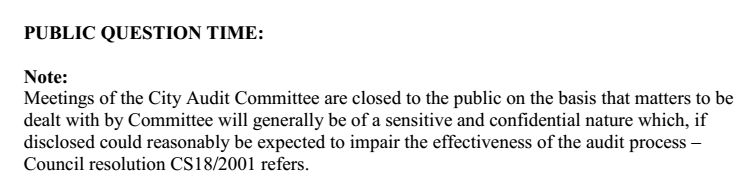
That is to say, Local Law Standing Orders 2000 prescribe the meeting to
be open to the public but a former Council resolved not to do it anyway. The
current Council has kept it that way. So much for local laws.
The City Audit Committee is the one place where Electors might ask why
certain expenditures were made or why certain projects were undertaken – but
no, that is not permissible of this Committee.
Importantly, the Annual Report, presented to Electors at the statutory
Annual Meeting of Electors, bears a disclaimer by its independent accredited
professional auditors to the effect that only the financial records of the
local government were audited – but not what the money was spent on.
In other words, so long as the Balance Sheet balances all is well.
That process is sure to develop a high level of confidence in Electors
to underpin accountability.
Examination of the past Minutes of this committee show there has been no
confidential information on record justifying closing of the meeting to the
public. In any event the public may be excluded for part of a meeting if
necessity arises.
It is also the case that the City of Armadale local government applies
an official "DISCLAIMER" to Committees.
The effect of the Disclaimer is that all or any
responses provided from a Committee mean absolutely nothing and are not
binding.
So why should a rational person ask any questions at
all ?
Importantly in the case of the City of Armadale Local Government, being
only one of fourteen Councillors, an individual ward Councillor has no capacity
to influence the Council's decision making process other than to express one
vote in fourteen. A dissenting voice may trigger debate under the jurisdiction
of Local Law Standing Orders 2000, but dissent to Committee recommendations is
subject to vote by the whole Council. Debate is not permitted on matters not on
the published agenda for the meeting.
It is obvious from the terms of the ban and censorship imposed by the
City of Armadale Local Government that the City has no regard for the Rule of
Law - except when applied by it to those it governs and when it suits its
purpose.
Its documented track record shows it considers itself to be above public
scrutiny.
It is the case that there is no requirement in law for a local
government to respond to any question, complaint, or request put to it in
writing - or, in fact, to respond to any letter at all.
Consequently, but noting Local Law Standing Orders 2000 prohibit making
statements or putting oral or written complaints or requests to Council or
Committees, the only available option is to submit direct personal oral
questions to an Officer or a Councillor, as the only alternative lawful means
of enquiry.
Unfortunately, oral discussions and responses are not on the public
record so an Elector proceeds at his or her own risk.
This system also prevents interested persons or groups of people
discovering what issues or concerns other citizens may be interested in.
"Freedom and not servitude is the cure of anarchy; as religion, and
not atheism, is the true remedy for superstition.
Deny them this participation of freedom, and you break that sole bond,
which originally made, and must still preserve the unity of the empire."
Edmund
Burke (1729 – 1797)