PART 8:
THE FACTS
8.1: DUE
PROCESS
The personal ban imposed upon myself was
originally declared in a letter to me dated 20 August 2015 under the hand of
the CEO.
That letter stated in part:
"……..it is not practical or in the public
interest to respond to these at Council or committee meetings."
"……..in accordance with the Presiding
Person’s determination your questions have “been referred to the administration
to be dealt with as normal correspondence”.
"I consider the amount of time spent by
officers responding to your questions as excessive and an unreasonable
diversion of City resources
away from other operations and
customers."
"Due to the above I wish to advise all
questions received from you in future will be received and assessed as to
whether they:
•
relate to similar questions raised and have already been responded to;
• are
a reasonable request for information to assist resolve a real and genuine
issue;
• are
a genuine request for service;
•
will divert an unreasonable amount of officer time away from other
functions;
• are
a genuine complaint about the standard of service received, the conduct of an
officer or the actions or lack of action by an Officer or a City appointed
contractor or agent.
Subject to the above a decision will then be
made as to whether a response is practical and reasonable under the
circumstances."
The inference from this ban is that
my questions were not in the public interest and did not meet the criteria
specified above.
However the questions directly related to legislation
being considered by Council at the time – i.e statutory review and amendment to
Local Law Standing Orders 2000, and consequences upon Councillors and the
effective operation of Council business arising thererom.
The Local Government Act 1995
prescribes the making of legislation is a specific function and responsibility
of Council.
In my view the Council was being
misled by its Mayor (the Person Presiding) and CEO because the proposed Standing
Orders were unlawful because both the existing and proposed Standing Orders had
been superseded by the Local Government (Official Conduct) Amendment Act 2007
and Local Government (Rules of Conduct) Regulations 2007 – eight years before
this debacle
That is, Local Law Standing Orders
2000 was not only out of date by eight years but was conceptually null and
void.
The questions were put to Council at
its 13 July 2015 meeting during Public Question Time.
These are the
questions and responses. (select and click to view)
By referring the questions to the CEO
to devise a response "administratively" (even though every Councillor
was given a copy by the CEO), the questions
were not minuted. Council was thereby able to keep the matter out of the
public domain and hidden from Elector awareness and consideration.
Contrary
to Council Policies 5.1.29 and EM6, Management Practice EM6 and Local LAW Standing Order
3.3:
10.
When a question is taken on notice under sub-clause 4(c)(iii) a response is to
be forwarded to the member of the public in writing by the CEO or the
respective ExecutiveDirector, and a copy is to be included in the agenda of the next meeting of the
Council or
committee as the case requires.
the
questions and responses were NOT attached to the Minutes of Council's next
meeting of 27 July 2015, suggesting a deliberate attempt to hide the matter
from Electors – a clear breach of the law.
The Minutes of Council Meeting 13
July 2015 record:
4 PUBLIC QUESTION TIME
Mr D
Grimwood was in
attendance at the Council
meeting and presented
41 questions mostly
relating to Council’s Standing Order Local Law. Mr Grimwood was made aware of the procedures
for public question time and agreed that
it would take an onerous amount of time if all these questions were put and
responded to.
Note: ALL of the questions related to Standing Orders
(i.e. not "mostly")
The Mayor
advised that the
41 questions would
be referred to the
administration to be
dealt with as
normal correspondence and
a response would be forwarded to
Mr Grimwood as soon as possible.
The Minutes of 27 July 2015 record:
3 ADVICE OF RESPONSE TO PREVIOUS PUBLIC
QUESTIONS
TAKEN ON NOTICE
Nil
The Minutes of 19 August 2015 record:
3 ADVICE OF RESPONSE TO PREVIOUS PUBLIC
QUESTIONS
TAKEN ON NOTICE
Nil
The Minutes of 24 August 2015 record:
3 ADVICE OF RESPONSE TO PREVIOUS PUBLIC
QUESTIONS
TAKEN ON NOTICE
Nil
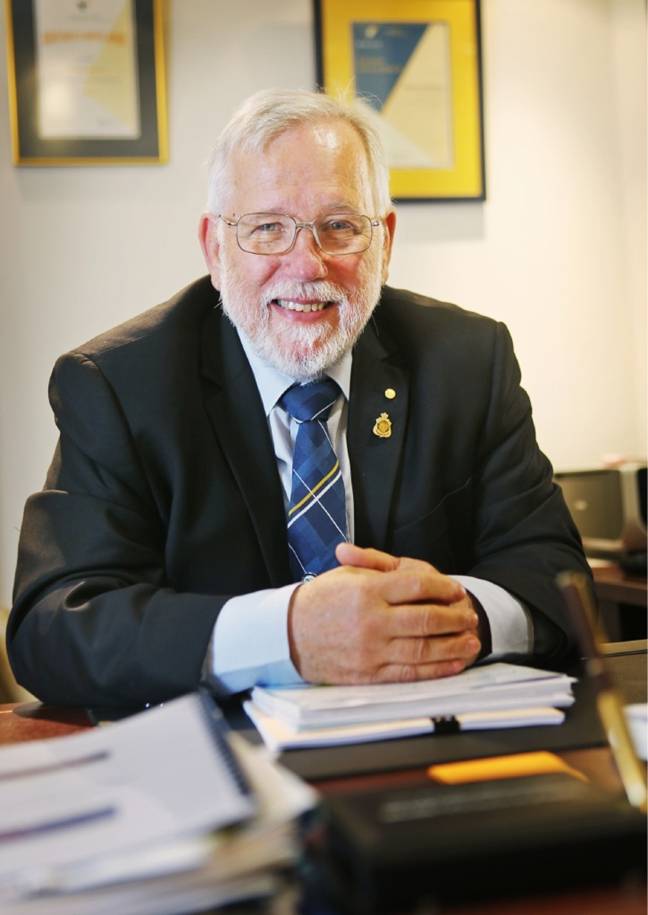
This is Mayor Henry Zelones OAM JP,
who personally imposed the ban:
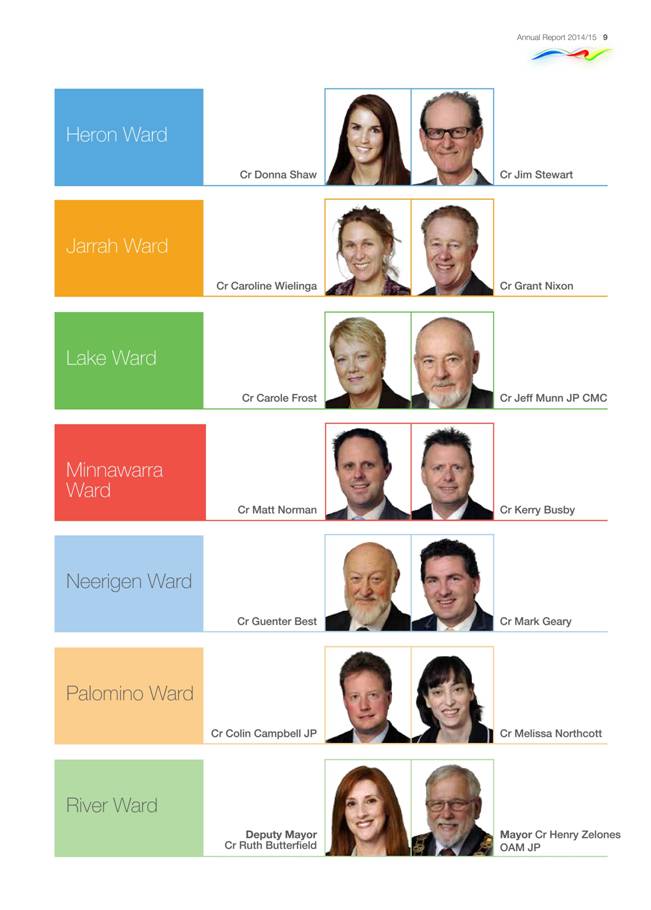
This is the 2013-2015 Council that (unoffically)
supported that ban:
Note it includes three Justices of the Peace.
Following some further exchanges, the CEO wrote to me
on 6 November indicating he would ask the Mayor to formally impose the ban at
its 9 November 2015 meeting.
To be certain, I asked Council, via Public Question
Time during its meeting of 9 November 2015, to formally resolve this ban to be its
decision and not just that of their Mayor, CEO and Acting CEO – i.e. on 9
November 2015 I asked Council itself, in the formal manner set out below, to
officially ratify the ban.
Pursuant to Reg 7 (2) of the Local Government
(Administration) Regulations 1996, I orally indicated to full Council via a
specific public question that if they chose to support the ban I would lodge a
formal complaint to the relevant higher authority.
This is the text of the question and response from the
Mayor, speaking for Council and the local government:
4 PUBLIC QUESTION TIME
1 Mr Grimwood was advised
that 15 minutes was allotted to public question time and he may put no more than 2 questions along with other
members of the public and in the
event of no other questioners
a maximum of 6 questions
within the prescribed time. (of 15 minutes)
Q1: Public Questions
Council, your CEO advised me in writing (Ref G/CM/7 20 August
2015) that I am henceforth restricted to
the asking of “public questions” to
“the City” on no more than four
occasions per year.
(a) Council, given
the minuted record
shows, “public questions”
from myself have not
been put and
responded to in
any Council or
Committee meeting since 2006 –
i.e. nine full years, how can such a uniquely imposed personal ban be justified
when under your
historical policies and
practices Council or Committee
meetings are the
only reliable means
for ratepayers to ask
questions and receive responses?
(b) Council, given there
is no authority in law for the CEO, Person Presiding or Council to
make this “policy”
determination having the
intent of directly extinguishing my civil and political
rights, I am obligated to lodge a formal S5.114 “serious breach” complaint to
the relevant authority, however, if it is the will of the current newly
constituted Council that such a ban be imposed, I ask that it be a formal
decision of Council, with the minuted record recording the names
of those supporting
it to enable
me to correctly
assign responsibility for this
decision in my
complaint instead of
naming all Councillors?
RESPONSE: The Mayor advised that while he has been
Mayor all questions put to this Council have
either been answered
at the meeting,
taken on notice
or dealt with administratively.
There is a
history on the
type of questions
being put consisting
of lengthy statements and
multiple parts to each question. The Local Government Act and Regulations
prescribes the conduct of Public Question Time and Council’s Policy outlines
the procedure with the Presiding Officer making the judgement on how
questions will be dealt with.
The Mayor invited
Mr Grimwood to
invoke his entitlement to lodge a
complaint with the relevant authority.
In terms of
a formal decision
of Council, there
is no provision
during public question time for a
formal recommendation to be put to a vote by Council.”
(end quote)
Note 1: The above question had two
parts, which made it two questions under the discretional ruling.
Note 2: Re “there is
no provision during
public question time for a formal recommendation to be put to a vote by
Council”, Local Law Standing Orders 3.10, 3.12
and 11.1 (f) provide a Councillor may move to challenge a ruling from the
chair.
Given his long experience, it follows
the Mayor’s response was deliberately false and misleading.
Note 3: The reference to “lengthy
statements” was the result of many years’ rejection and/or deviant responses
from the Person Presiding to simple questions. It was found by experience that
the more succinct the question, the more likely a rational or meaningful
response, so the questioning technique was forced upon me by Council.
Note 4: The recording of responses
without its corresponding question that sets out the basis for the question is
a technique long applied by Mayor Zelones. It makes the formal official minuted
record meaningless waffle.
Note 5: There is no mention fo the
term "ban" in the Mayor's response.
However, exercising his discretional powers under City
of Armadale Local Law Standing Orders 2000,
and in full view of Council, the Mayor discretionally declined to put
the matter before Council and no Councillor moved to have the matter raised or
challenged – either there and then or at any other time since - thereby
endorsing by default the ban imposed under the hands of the Mayor, CEO and
Acting CEO .
In relation to my question – "if
it is the will of the current newly constituted Council that such a ban be
imposed, I ask that it be a formal decision of Council, with the minuted record
recording the names of
those supporting it
to enable me
to correctly assign responsibility for
this decision in
my complaint instead
of naming all Councillors?" -
the sycophant Council shown above not only supported the
ban imposed by their Mayor and CEO but also, notwithstanding I had already
advised it that the ban was unlawful, remained passively silent and failed to
formally discuss or consider it in Committee or in Council.
It had a statutory duty to comply with the law and to
comply with its formal policy for openness, transparency and accountability –
but it chose to ignore that duty.
There is no documented record of this matter ever
being put before a Council or a Committee.
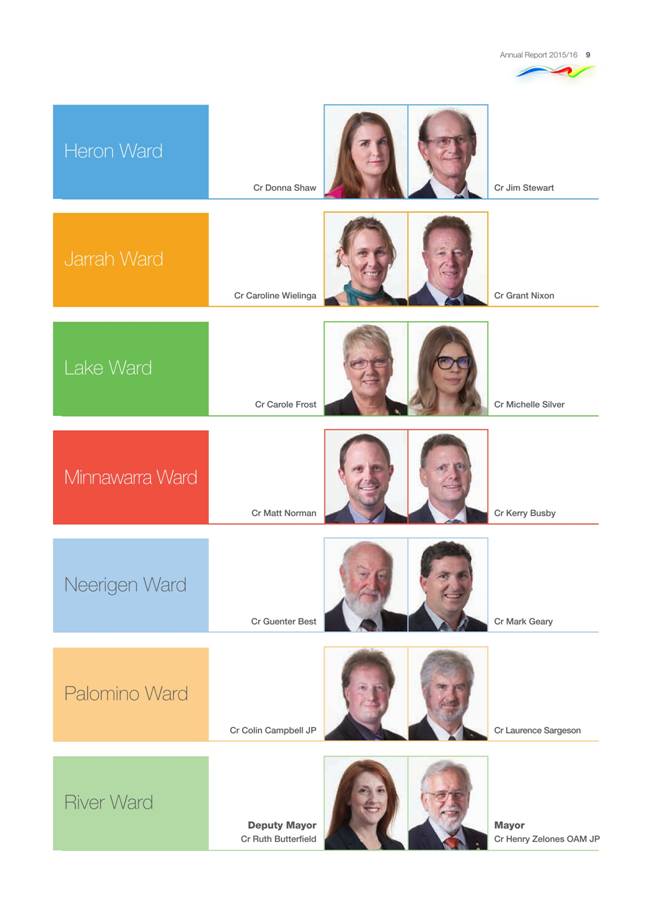
Following the October 2015 Local Government
Election, this is the reconstituted 2015-2017 Council that by default openly
supported the ban as presented to it at its 9 November 2015 meeting via my
questions.
From that time on it could not deny being
aware of the ban, yet has done nothing since to withdraw it (because it is unlawful):-
COUNCIL MEETING 9 November 2015
2
RECORD OF ATTENDANCE / APOLOGIES / LEAVE OF ABSENCE
(previously approved)
PRESENT:
Mayor, Cr H A Zelones OAM JP River Ward
presided over:
Deputy Mayor, Cr R Butterfield River Ward
Cr J A Stewart Heron Ward Cr M H Norman Minnawarra
Ward
Cr D M Shaw Heron Ward Cr K Busby
Minnawarra Ward
Cr G Nixon Jarrah Ward Cr C M Wielinga Jarrah
Ward
Cr C Frost Lake Ward Cr M Silver Lake
Ward
Cr G A Best Neerigen Ward Cr M Geary
Neerigen Ward
Cr L Sargeson Palomino Ward Cr C A Campbell JP
Palomino Ward
That ruling from the Chair resulted in a formal complaint
being submitted by myself to the Director-General, Department of Local
Government and Communities.
Notwithstanding this ban has not been authorised or
confirmed by resolution by Council, the Department responded with support for
the Mayor and CEO's respective autonomous, autocratic and discretional
executive decisions.
The essence of the Department's determination is that
"matters" or "subject matter" are classed as
"procedures". However, as is noted below, the actual formal notice of
the ban was issued by the CEO and Acting CEO, neither of whom are granted
powers under the Local Government Act 1995 to impose such as ban, which voids
rights expressed by the WA Criminal Code.
Subsequently, since this issue and the decisions
arising from it affect ALL local governments in Western Australia, I
sought a meeting with the Minister for Local Government and Communities to
discuss suggested generic changes to the Local Government Act and Regulations
required to support international democratic rights under the Rule of Law.
This meeting was declined.
The Minister chose not to hear me but to refer the
matter to his Department for administrative response.
The Department again confirmed by written response it
believes the ban is valid and no changes to legislation are warranted.
It is disappointing that the Minister, who represents
the Crown and duty bound to uphold the Rule of Law, declined to express
interest in the matter.
It is ironic that in the Australian system of government,
a Mayor or Shire President is given absolute power in law – a power that even
the Prime Minister does not have.
The evidence is presented below.
CLAIMED LEGAL BASIS FOR THE BAN:
The above referenced determination by the
Western Australia Department of Local Government and Communities declares that
"matters" before Council or Committee are deemed to be
"procedures" - ie there is no difference between "matters"
and "procedures".
8.2: THE
FACTS - PROCEDURES V MATTERS:
The term "procedure" is commonly
defined: "A fixed, step-by-step sequence of activities or course of
action (with definite start and end points) that must be followed in the same
order to correctly perform a task."
Source: http://www.businessdictionary.com/definition/procedure.html
The term "matter" is commonly
defined: "Focus, subject, or theme of a discussion, or assertion
forming the ground for a claim, disagreement, or litigation."
Source: http://www.businessdictionary.com/definition/matter.html
The WA Interpretation Act 1984 defines:
Section 6: Definitions in a written law, application of
"Definitions or rules of interpretation contained
in a written law apply to the construction of the provisions of the written law
that contain those definitions or rules of interpretation as well as to other
provisions of that written law."
Since the terms "matters" and "procedures"
are not defined by, but used extensively throughout, the Local Government Act
1995 and its subsidiary regulations as having distinctly different meanings, it
is clear the above interpretation of Sections 5.24(2), 5.25 (1) (a) and (c),
5.27 (3), 5.31 and 5.68 (1) and (3) by the Western Australia Department of
Local Government and Communities is incomprehensible, subjective, unsupportable
and has no basis in law.
The WA Interpretation Act 1984 defines:
Section 43: Power to make subsidiary legislation, general provisions
about
(1) Subsidiary legislation shall not be
inconsistent with the provisions of the written law under which it is made, or of any Act, and subsidiary legislation shall be void to the extent of any such
inconsistency.
(2) Where any
subsidiary legislation purports to be made in exercise of a particular power or
powers, it shall be deemed also to be made in exercise of all powers under
which it may be made.
The Western Australia Department of Local Government
and Communities relies upon S5.25 (1) (c) of the Local Government Act 1995,
which prescribes:
"Without limiting the generality of section 9.59, regulations may make
provision in relation to — the procedure to be followed at, and in respect of,
council or committee meetings;"
and S9.59, which prescribes;
9.59. General regulations
(1) The Governor may make regulations prescribing
all matters that are required or permitted by this Act to be prescribed, or are
necessary or convenient to be prescribed for giving effect to the
purposes of this Act.
(2) Without limiting subsection (1), regulations
may be made as to —
(a) the selection, employment and functions of
employees of local governments; and
(b) the keeping of documents and records by a
local government; and
(c) the procedures to be followed by a local
government or any other person in carrying out functions under this Act.
however the supporting regulations, being the Local
Government (Administration) Regulations 1996, are silent on the matter, thereby
(sic. "unlawfully") authorising the person presiding to determine
"procedures" absolutely.
Extrapolating from the above ruling, which regards
"matters" and "procedures" to be one and the same, it is the
case the Western Australia Department of Local Government and Communities has
determined that the person presiding over Council or Committee meetings has
"absolute" power to make discretional decisions about
procedures" and/or "matters" before Council or Committee -
either before or after the event - under powers and authorities deemed to be
derived from the Local Government Act 1995 and its subsidiary regulations
and/or local laws.
Therefore, pursuant to, but notwithstanding, S2.8 (1),
S5.24 (2), 5.31 and S9.59 (2) (c) of the Local Government Act 1995 and Local
Government (Administration) Regulations 1996, in the case of Public
Question Time and Elector meetings, the person presiding can - irrespective of
any limitations or conditions imposed by Standing Orders and/or the City's Code
of Conduct - and irrespective if the Standing Orders are a local law or not - discretionally determine absolutely
the manner in which any matter may be processed, or absolutely determine
or rule in or out any matter or any aspect of it - including changing or
falsifying or manipulating the minuted record of decisions or meetings.
Having regard to S43 (2) of the WA Interpretation Act 1984 as set out above, it
follows then that this power also applies to ANY business before Council or
Committee.
Coupled with the Mayor or Shire President's statutory
right to "speak for Council" it follows that the Mayor or Shire
President may act as a dictator or autocrat with impunity - if he or she so
chooses !!!!
Now that is democratic government !!
There is no avenue for appeal because, in the view of
The Western Australia Department of Local Government and Communities, the absolute
power of the person presiding is "lawful".
An operating environment that vigorously repels
scrutiny by those citizens it purports to represent is a sure formula for
preservation of the status-quo, a mediocre standard of government,
inefficiencies, waste, autocratic decision making and facilitates corruption
Thus the current local government system in Western
Australia does not support basic principles or rights under the Rule of Law in
relation to Electors, Ratepayers, Residents or the Public.
See also: http://www.hcourt.gov.au/assets/publications/speeches/former-justices/gleesoncj/cj_ruleoflaw.htm
For all the power the government has,
being only for the good of society, as it ought not to be arbitrary and at
pleasure, so it ought to be exercised by established and promulgated laws, that
both the people may know their duty, and be safe and secure within the limits
of the law, and the rulers, too, kept within their due bounds...
John
Locke
8.3 Access to Council,
Committees and the Administration
The City of Armadale local government holds approximately
72 meetings of Council and its sub-committees per annum
There is also a statutory "Annual Meeting of
Electors", which is usually structured as a question time FORUM rather
than a “meeting”.
Consequently the above ban has the effect that, depending
upon the number of parts to a question, a total of four to twenty four
questions, including parts, be permitted per annum - but on no more than four occasions.
That means if one question is put on each occasion
then only four questions may be
asked per annum - but NOT necessarily
accepted or responded to.
It has the effect that if a question is put such as "What
was the expenditure on "X" for the years 2010, 2011, 2012, 2013, 2014
and 2015" then that question comprises six parts - consuming one
quarter of a year's quota
This ban also has the effect that if the person
presiding (usually the Mayor) so determines, then "Questions
raised on matters not currently before
Council and that relate to the City’s affairs be
referred to the CEO to deal with administratively."
That condition has the effect that Committees,
through which most business passes before reaching Council for its
consideration, are excluded from questioning - because Committees are not
"Council". Committees of the City of Armadale have no powers or
duties, are not part of Council but are acting for it as a servant.
Their output is limited to reports and recommendations
to Council. They have no power to instruct the Executive to do or not do
anything.
City of` Armadale Committees do not have delegated
powers or duties.
Matters before Committees are NOT "matters
currently before Council".
i.e. unless
and until a matter is placed on a Council Agenda it is not "currently
before Council".
In practice, Agendas are normally issued just 72 hours
before each Council or Committee meeting, thus it is not possible to determine
if a matter is "currently before Council" until 72 hours maximum
before its next meeting.
Since Council meets on a Monday night, and Agendas are
issued publically on either Friday night or Saturday morning, the public have
just the weekend to be informed of "matters before Council", do their
research, formulate responses and prepare questions. Those persons who do not
have on-line access have only the remainder of Saturday morning and Monday to
attend their nearest library to view minutes and discover if an item of
interest is on the Agenda. This regime has been in place for at least 18 years
and shows no sign of changing.
In any event, it is also the case that the City of
Armadale local government applies an official "DISCLAIMER"
to its Committees. The effect
of the Disclaimer is that all or any responses provided from a Commitee mean
absolutely nothing !!!!
Council meets 12 times per year - thus a limit of four
questions or sets of questions per annum means one can ask questions at only
one third of Council meetings - now that's democracy in action !!!!
If Committees are included, the number of meetings increases
to 72 - ie one can ask questions at only one in 18 meetings !!!!
Furthermore, ONLY the CEO and Mayor or President can
"speak" for the local government, so unless they personally respond
to a question then any response provided is purely a personal opinion and has
no standing.
Importantly, the Local Government (Official Conduct) Amendment Act 1997 and
its Local Government (Rules of Conduct) Regulations 2007 define
standards of conduct for Councillors - but do not apply to the CEO and
Administration officers. Hence questions to the elected Council regarding
contentious matters may be delegated to the CEO/administration for response -
as has happened on several occasions in my case - thereby removing Councillors
from obligations under those provisions - ie a simple mechanism to completely
bypass the Official Conduct requirements of the Local Government Act 1995.
That methodology - as applied in this case - has the
intent of providing the elected Council full immunity from its decisions and
actions.
In the case of officers, complaints regarding conduct
must be submitted to the CEO.
In the case of the CEO, complaints regarding conduct
must be submitted to the Council (via the CEO) to the Mayor or President.
Moreover, City of Armadale Local Law Standing Orders
2000 proscribes at SO 8.4: (3) "No member of the Council, or a committee, or member
of the public is to reflect adversely on the character or actions of a member,
officer or any other person participating in the meeting.", thereby
prohibiting any person from complaining directly to Council or Committee about
the actions or conduct of a Councillor or officer."
It is a standing requirement that all correspondence
to Council or Committees be addressed to the CEO. Therefore the situation is
that a complaint about the CEO must be submitted to the CEO. That process breaches the convention for
"Natural Justice".
The two rules of natural justice, namely, nemo
judex in causa sua and audi alteram
partem, have
now a definite meaning and connotation in law and their content and
implications are well understood and firmly established
Source:
http://www.publications.parliament.uk/pa/ld199899/ldjudgmt/jd990115/pino02.htm
http://scholar.harvard.edu/files/pmalysz/files/malysz_-_nemo_iudex_in_luther.pdf
https://en.wikipedia.org/wiki/Audi_alteram_partem
Great system !!!!
Note: In relation to the Rule of Law, the specific additional
Standing Order requirement enjoining "a member of the
public" was devised by Council under the then leadership of Mayor
Roger Stubbs OAM AM, (and now "Freeman of the City") and Deputy Mayor
Geoff Munn JP, reviewed by the WA Parliament, granted Royal Assent by the
Governor of Western Australia and gazetted in 2000, as a coercive strategy to
silence public concerns at the then Council’s conduct.
It has been since reviewed and re-endorsed on two occasions
since - via the same process and under the leadership of two subsequent Mayors
- in accordance with the statutory maximum eight year review period.
In each case of review, Council's attention was drawn
to the negative implications of this requirement in relation to the explicit
principles of the Rule of Law. In other words, successive Councils have been
fully aware of its implications but ignored their statutory duty to uphold the
Rule of Law.
Noting Section 10(c) of the WA Interpretation Act 1984,
it could be argued this requirement [SO8.4: (3)] applies equally to all
Councillors or Committee members and officers present as a collective. One
could easily find oneself facing a Court after incurring the angst of a single
Councillor or officer acting on behalf of the collective.
The records of the WA Local Government Standards
Panel, State Administrative Tribunal and the WA Supreme Court demonstrate some
WA Councillors and Executive Officers have been easily offended by comment
about themselves.
However any prosecution of a Ratepayer, Resident,
Elector, Citizen or "Member of the Public" will be in the criminal
jurisdiction, thus a conviction will incur a criminal court record.
Most sensible people would be intimidated by that
imposition and simply stay away from Council matters – so they do.
Noting there is no automatic protection for
complainents from the laws of libel, the system thereby provides a closed loop
environment where the master protects the servant and the servant protects the master.
If challenged in law, Councillors and staff are
protected by the financial resources of the local government, who is given
discretional statutory authority to defend its Councillors and staff.
The political censorship included in the terms and conditions
of this ban also have the effect that any question may be rejected on any
grounds - WITHOUT JUSTIFICATION
OR EXPLANATION !!!!
Welcome to the fascist state.
Notwithstanding City of Armadale Local Law Standing
Orders 2000 and the Local Government Act 1995 bestow to the person presiding
absolute power to determine "procedures" for a meeting, there is NO
process available to a questioner to challenge or change any ruling of the
person presiding - even if shown to be unlawful at the time it was made.
The writer is the only Elector from an electorate of
more than 44,000 Electors who is banned.
The writer is the only Citizen from a local government
district population of more than 84,000 persons who is banned.
That is significant – and unlawful.
"The rule of law is democracy's
answer to the rule of men. In 1603 James I considered himself as standing above
the law. He could and did deal with people as he saw fit. He authorised the
torture of Guy Fawkes, he exacted compulsory loans from the nobility without
the sanction of parliament. The establishment of the rule of law was the great
product of the constitutional struggles in England during the 17th century. By
the time the Stuart monarchs were replaced by the House of Hanover, they
acknowledged that they ruled under the law and subject to it.
The rule of law requires that all people, including the
head of state and the executive government, are subject to the law, and that
independent judges are the arbiters of law. By this means, governments are
accountable for their actions."
The Ninth Manning Clark Lecture
Presented at the National Library of Australia by Julian Burnside, Canberra, 10
March 2007
Source: http://www.safecom.org.au/burnside6.htm