PART 19: OFFICIAL REVIEW OF LOCAL
GOVERNMENT ACT 1995
SCHEDULED FOR COMPLETION IN 2018
1. BACKGROUND:
In 1997 the National General Assembly of Local
Government, convened by the Australian Local Government Association, proclaimed
its
DECLARATION ON THE
ROLE OF AUSTRALIAN LOCAL GOVERNMENT:-
“as a standard to which all Australian governments
should aspire in their efforts to achieve a more effective democratic process
and secure the environmental, social and economic wellbeing of their
constituents.”
In 2006 the Western Australia Parliamentary Public
Accounts Committee enquired into Local
Government Accountability. Its findings are published in Report No. 4
Also in 2006 the Local Government Advisory Board
completed a review entitled Local Government
Reform in Western Australia - Ensuring the
Future Sustainability of Communities.
The LGAB Report stated at Page 5:
"It acknowledged as fundamental principles that
local governments are elected to represent their local communities;
·
to be a responsible and accountable sphere of democratic
governance;
·
to be a focus for community identity and civic sprit;
·
to provide appropriate services to meet community
needs in an efficient and effective manner; and
·
to facilitate and coordinate local efforts and
resources in pursuit of community goals.
Local government thus plays a number of roles, among
them governance, service delivery and facilitation, advocacy, community
development, planning,
regulation."
In 2009 Curtin Academic Roy Jones published the following
paper:
Local government in
Perth: nineteenth century administration for a twenty first century city?
In 2011 the then Western Australia State Government
commissioned a major strategic Inquiry into local government (30 Local
Governments) in the Perth metropolitan area by The Independent Metropolitan
Governance Review Panel (commonly known as the "Robson Review") in
the following terms:
TERMS OF REFERENCE
The Independent Metropolitan Governance Review Panel has been
asked by the Minister for Local Government to:
·
Identify
current and anticipated specific regional, social, environmental and economic
issues affecting, or likely to affect, the growth of metropolitan Perth in the
next 50 years.
·
Identify current
and anticipated national and international factors likely to impact in the next
50 years.
·
Research
improved local government structures, and governance models and structures for
the Perth metropolitan area, drawing on national and international experience
and examining key issues relating to community representation, engagement,
accountability and State imperatives among other things the panel may identify
during the course of the review.
·
Identify new
local government boundaries and a resultant reduction in the overall number of
local governments to better meet the needs of the community.
·
Prepare
options to establish the most effective local government structures and
governance models that take into account matters identified through the review
including, but not limited to, community engagement, patterns of demographic
change, regional and State growth and international factors which are likely to
impact.
·
Present a
limited list of achievable options together with a recommendation on the
preferred option.
The Independent Metropolitan
Governance Review Panel has been asked by the Minister for Local Government to
report on the above by June 2012.
THE
REVIEW:
In addition
to the Issues Paper
and Draft Findings,
over 40 background and briefing
papers were produced.
Nearly 450
submissions were made
to the Panel
FINDINGS:
In 2012 the
independent Metropolitan Governance Review Panel reported its findings to the
Government in the following terms:
THE
GOVERNMENT'S RESPONSE:
Following due
deliberation and consideration, the Western Australia Government responded in
the following terms:
Department of Local Government and Communities Metropolitan
Local Government Reform Website
In 2014 the
Local Government Advisory Board conducted yet another Review entitled Local
Government Advisory Board Metropolitan Local Government District Inquiries
Report
The
Board called for submissions on proposals on four separate occasions, involving
a total of seventeen weeks consultation which resulted in the
receipt
of over 30,000 submissions from the public. In addition to this the Board
convened approximately fifty meetings with key stakeholders
In 2015 the Western Australia Parliamentary Public
Accounts Committee enquired into Improving
Local Government Accountability. Its findings are published in Report No. 12
In 2015 UWA Academic Roy Jones published the following
paper:
.
2. IMPLEMENTATION PROGRESS
Not much has
happened since and the status-quo has not only been preserved, but well
protected by the Parliament
3. 2017 REVIEW
In March
2017, the newly elected Labor Party Government announced yet another review
into local government.
The
Government says: "For the first time in more than 20 years, the Local
Government Act 1995 is being reviewed to modernise the outdated laws and reduce
red tape."
Note however
that a full five years have passed since the previous review. It appears to
have been filed away – never to be seen again.
It is
reasonable to assume from the Government's statement that nothing of
significance has been done to improve the LG system for 20 years !!
WALGA
RESPONSE
Responding
quickly to the announced review, the Western Australia Local Government
Association, a lobby group acting for the local government industry, published
a set of proposed amendments as a basis for discussion by its member local
governments.
The WALGA
proposals currently under statewide discussion have already been considered and
unanimously endorsed (with minimal modification) by the City of Armadale Local Government
– the primary object of this website report.
WALGA says:

Compare that
statement with the evidence presented in this report.
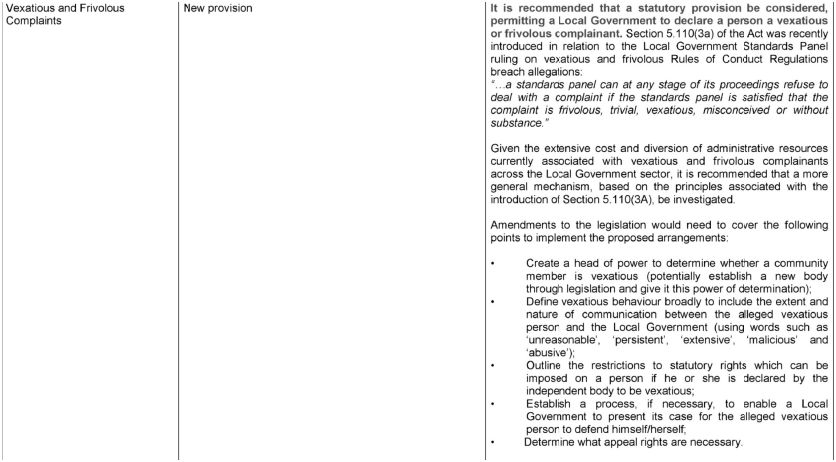
The term
"vexatious" is formidable to a dissident.
The Western
Australia Vexatious Proceedings Act 2002 defines "vexatious
proceedings" as:
Section 3: vexatious
proceedings
means
proceedings —
(a)
which are an abuse of the process of a court or a tribunal; or
(b)
instituted to harass or annoy, to cause delay or detriment, or for any other
wrongful purpose; or
(c)
instituted or pursued without reasonable ground; or
(d) conducted in a manner so as to harass or annoy, cause
delay or detriment, or achieve any other wrongful purpose."
On the face
of it then it would be the case that if your friendly Council is
"annoyed" by your questions, then you may be classed as "vexatious".
Then there
is "detriment". Obviously it is "detrimental" for a Council
which has lied or misled or actually done something it should not have to be
shown up.
The real
danger to democracy here is Section 10, which prescribes;
10. Regulations
(1) The Governor may make regulations prescribing all
matters that are required or permitted by this Act to be prescribed, or are
necessary or convenient to be prescribed, for carrying out or giving effect to
the purposes of this Act.
Note: The High Court
of Australia noted in Oceanic Sun Line
Special Shipping Company Inc v Fay [1988] HCA 32; (1988) 165 CLR 197 (30 June
1988)
"Vexatious"' today has overtones of irresponsible pursuit of litigation by someone who either knows he has no proper cause of action, or is mentally incapable of forming a rational opinion on that topic."
27. In retrospect, the English law can be seen to have moved from a discretion confined by a tolerably precise principle to a broad discretion to be exercised according to the judge's view of what is suitable "for the interests of all the parties and the ends of justice". The new approach can offer little guidance to a judge in ascertaining what is "suitable" when the parties have opposing interests, when advantage to one is disadvantage to the other, and when the choice of forum is the very means by which one party's interest is preferred over the other. Once the test involves a balancing of the interests of plaintiff and defendant, the court is inevitably involved in a discretionary conferring of an advantage on one party and a disadvantage on the other; it is involved not in the enforcement of existing rights and liabilities but in the creation, modification or abolition of rights and liabilities. If the touchstone to guide the exercise of such a discretion is to be "the ends of justice", how can a court decide what is just in the particular case except by reference to the law which would govern the matter if it were tried in that court? Even if it were right to disregard procedural advantages involved in refusing a stay, how can a court decide that the ends of justice are served by granting a stay if the law applied in the alternative forum imposes substantive disadvantages - as, for example, by holding a claim to be time-barred, by assessing damages at a higher or lower level or, as perhaps in the present case, by construing a contract differently? The justice which our courts dispense is justice according to our law; the courts cannot compare justice according to differing laws in order to say what satisfies the ends of justice in some abstract sense. The function which the courts of this country would be required to perform if the new English approach were adopted would, in my respectful view, be inconsistent with what we have hitherto understood to be the function and the duty of courts: the function of enforcing rights and liabilities according to the law of the forum (including private international law) and the duty to exercise jurisdiction which is regularly invoked unless the invocation of the jurisdiction is oppressive, vexatious or otherwise an abuse of process.
29. Our jurisprudence is
designed to protect the litigant against an unnecessarily wide discretionary
power: optima est lex quae minimum relinquit arbitrio judicis, optimus judex
qui minimum sibi. Broom's Legal Maxims, 10th ed. (1939), p 46, translates:
"that system of law is
the best, which leaves least to the discretion of the judge - that judge the
best, who relies least on his own opinion".
The maxim expresses a value
fundamental to the legal system of a free society. A legal right cannot be
defeated by the exercise of a judicial discretion though there may be occasions
when the court must determine whether there is a countervailing public interest
to which the legal right is subordinated (as where the court refuses to enforce
a contract which is contrary to public policy). Generally speaking, it is of
the nature of a legal right that the person in whom it is vested is entitled to
invoke the state's power to enforce it. For that purpose the courts are at the
service of litigants, and the rule of law rests on the courts' duty to exercise
their jurisdiction when litigants invoke it.
30. Of course, no legal
system can dispense with the need for some discretion in the exercise of
judicial power in particular cases. But even when (as in recent times) judicial
relief is broadened to encompass new categories of cases, it is preferable to
develop legal principles binding both the courts and the parties where that means
of development is practicable rather than to confer judicial discretions to
determine whether relief should be granted or withheld. An extension of the
discretionary power of judges tends to establish a government of men rather
than a government of laws.
31. Once the court assumes a
wider discretion to refuse to exercise its jurisdiction, as the English cases
show, there is no turning back short of the point where the court, guided by no
more specific touchstone than the ends of justice, assumes the power to affect
the parties' substantive rights. The ineluctable course of decision in England
since The Atlantic Star leads me to hold that the true principle is, as Lord
Simon of Glaisdale put it in his dissenting speech in that case (at p 471):
"a plaintiff who founds
jurisdiction will not be denied a hearing unless he is misusing the forensic
process so as to perpetrate injustice."
The formulation by Scott L.J.
is, and should remain, the law of this country and "oppressive" and
"vexatious" should be understood according to their
ordinary meaning.
CITY
OF ARMADALE
The
City of Armadale Local Government has considered the above WALGA proposals and
responded as follows:-
City
Strategy Committee Report 18 September 2017
– accepted and endorsed by Council 26 September 2017.
What is
important to Electors is that, as at September 2017, the Council of the City of
Armadale considers the following to be good governance and good democracy:

That means
you do not get to choose who will represent you to lead the community.

Elector
meetings are the only forum available in which Electors may actually talk to
Council – albeit under strict procedural control.


The above
just makes it harder for the governed to seek a voice

See above
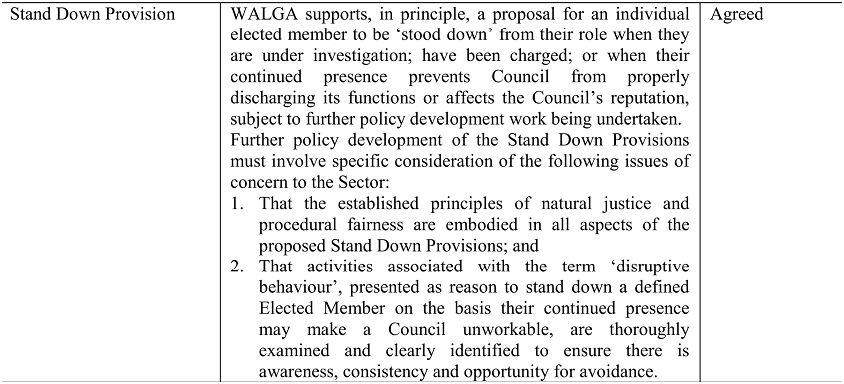
What this
means is that if a Councillor, on behalf of constituents, by his or her "continued presence"
continually opposes Council policies or decisions then they are likely to be expelled
– merely for "affecting Council's reputation".
Whatever
happened to decisions being made by vote ?
That is what
Standing Orders are for.
The above
proposal is squarely aimed at eliminating dissident Councillors.
Notice ALL of the above WALGA proposals REDUCE democratic
process – not improve it.
Notice
there is no proposal to eliminate wards, thereby facilitating the continuation
of pork barreling election processes.
Despite only
half of a Council being presented for election each two years, notice that
current election candidates claim to be able to change Council policies,
despite being always in a minority position on Council.
4. POLITICAL SLEAZE
Notice that
the above WALGA proposals relating to the future of local government in Western
Australia have been circulated immediately before the usual bi-ennial election,
to occur on 21 October 2017.
The effect
of City of Armadale Council's decision on 26 September – less than a month
before some of the Councillors are replaced – is that all or any new Councilors
will be excluded from the decision making process which affects them and future
Councils.
Thanks to
Council policies, new Councilors will be prohibited from challenging the
decisions of the past. This ethos is reflected in the proposal:-
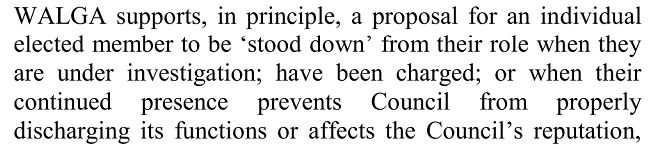
The most
notable feature of Council's recommendation is that it says:

I
did not receive natural justice when I was banned.
I
was not told WHY I was banned.
I
was not permitted to speak in my defence.
Where
did natural justice go?
Obviously
one law for the governors and a different – and lesser - law for the governed.
5. 2017 Local Government Act 1995 Statewide
Review Phase 1
CONSULTATION
PAPER AND PUBLIC SUBMISSIONS
In November
2017 the Minister for Local Government released the Government's Public Consultation Paper for
public consideration and comment and invited submissions from the public.
This review
will examine laws and policies relating to all 137 local governments throughout
Western Australia.
It is well
worth studying this document as it offers a glimpse of how local government
works in Western Australia and how the current Government sees its role in the
community.
Submissions
closed 9 March 2018.
Further
public submissions will be invited to Phase 2 of the review, later in 2018.
This is my
formal SUBMISSION in response to that paper and other pre-existing matters
and issues.
It is partly
legal, partly political and partly organisational design and management.
Please take
the time to read it and study the issues presented and solutions offered.
Due to the
complexity of the matters discussed the submission is complex however it should
be noted that local government depends entirely for its legal legitimacy – i.e.
the right to govern – from LAW.
See this
2004 Legal
Opinion from a leading LG specialist law firm re the constitutional
validity of local governments.
That it has
been 14 years since this was circulated throughout the LG industry, demonstrates
how self-serving that industry remains.
It is clear
that the whole body of law relating to local government is imprecise and
unclear and requires revision and amendment by Parliament.
It is also
clear that despite the numerous enquiries, reviews, recommendations and complaints
over many years, consecutive Parliaments have not been motivated to resolve the
issues identified by official research, investigation, consultation and
enquiries.
If you want
change please contact your local Member of Parliament and voice your opinions,
suggestions or concerns – that is democratic representation.
This page is
at http://www.banned.oestex.com/Part
19 R3.htm
email:
banned@aapt.net.au