PART 17 - THE SAGA OF
STANDING ORDERS
The concept of "Standing Orders" is credited to Sir Thomas Smyth, who published a book about them for the House of Commons in 1583.
source: https://en.wikipedia.org/wiki/Parliamentary_procedure
source: https://en.wikipedia.org/wiki/Principles_of_parliamentary_procedure
In the USA an abridged form was developed and first published in 1876 as the "Pocket Manual of Rules of Order for Deliberative Assemblies" – later morphing into"Roberts Rules of Order". This version is designed for "ordinary societies" rather than legislatures such as Parliaments and local governments.
In other words, in their various forms, Standing Orders have been around for a long time.
The core purposes of
Standing Orders are to set out clearly defined rules and procedures that have
been mutually agreed to by participants, having as their
objects:
* to ensure each participant understands the rules and
procedures to be applied to a meeting – before the event
* to provide an orderly form of meeting
* to ensure fairness
* to ensure equal opportunity for differing views or arguments to be
presented and heard
* to provide mechanisms for minorities to have a voice
* to ensure business is conducted efficiently
* to ensure ethical conduct
In Western Australia, the Legislative Assembly and Legislative Council of the Western Australia Parliament each apply similar, but different, formal Standing Orders to their meetings.
In Western Australia, local governments normally apply Standing Orders to their meetings.
However these are not the same as those used by the Parliaments.
One key difference is there is no "parliamentary privilege" in local government, which means that Council and Councillor Committee members are personally subject to the laws of defamation and libel in relation to interactions between themselves and third-parties, such as Members of the Public or private corporations.
It is assumed employed executive officers and support staff would not risk offering defamatory utterances during or outside meetings.
This environment has the effect that fair criticism is effectively banned by default.
Allegations or revelations of corruption, improper conduct or improper influence may not be made in a Council or Committee meeting, hence local government is fertile ground for backroom deals before, or externally to, meetings and the editing of minutes after meetings.
The law requires MInutes only record a summary of matters discussed, thereby assisting any propensity to manipulate process.
Curiously, the Local Government Act 1995 empowers each of the 138 Western Australia local governments to devise its own unique set of Standing Orders – despite conceptually uniform requirements for governing the governed.
These were caused by the Governor in Executive Council to be prepared and published under section 3.9 (1) of the Act.
Uniform Model Standing Orders were in fact gazetted on 03 April 1998 (GG No. 73), being known as "MODEL LOCAL LAW (STANDING ORDERS) 1998".
The intent was to introduce uniform Standing Orders throughout the state of WA. However this object was not to be fulfilled because the forward text of the SO declares:
Note—under
section 3.9 (1) of the Act, a local law under the Act may adopt the provisions
of the model local law by reference, with or without modifications.
Note—under
section 3.9 (2) of the Act, a model local law has no effect except to the
extent that it is adopted.
JOHN
LYNCH, Executive Director
The key word is "may".
The term WA Interpretation Act 1984 defines "may" to mean:
56. “May” imports a discretion, “shall” is imperative
(1) Where in a written law the word may is used in conferring a power, such word shall be interpreted to imply that the power so conferred may be exercised or not, at discretion.
(2) Where in a written law the word shall is used in conferring a function, such word shall be interpreted to mean that the function so conferred must be performed.
Some local governments opted not to adopt the Model Standing Orders, preferring their own versions.
However those local governments following the script are thereby empowered to include model Standing Order 8.4 Adverse Reflection:
(1) No member of the Council or a committee is to reflect adversely upon a decision of the Council or committee except on a motion that the decision be revoked or changed
(2) No
member of the Council or a committee is to use offensive
or objectionable expressions in reference to any member, employee of the
Council, or any other person.
Penalty
$1,000
The primary political strategy to make Standing Orders a local law is that since local laws are reviewed (not necessarily revised) only every eight years, it follows that every Council during that eight year period is bound by pre-existing law to follow the corporate line - or else.
The result has been that new Councillors may come and go but are denied, or never see, opportunity to change their meeting environment as a continuous improvement measure - or to give them opportunity to participate beyond a short time-frame during meetings.
Newly
elected Councilors are forced to accept the status-quo. Changing it is next to
impossible.
In the case of the City of Armadale Local Government, the approach taken has been to use Standing Orders to rigidly control meetings of Council, Committees (Standing Committees), sub-committees and various advisory committees and community reference groups.
To ensure meeting
participants do not stray from the straight and narrow by deciding their own
procedures, the City has constructed Standing Orders as a local law,
carrying substantial
penalties if breached. These are known as "City of Armadale Local Law
Standing Orders 2000".
In fact, as will be shown, City of Armadale Local Law Standing Orders 2000 have been the controlling procedure for 17 years, adopted by no less than three consecutive Mayors and their Councillor supporters.
City of Armadale Local Law Standing Orders 2000 has had a long evolution.
The Kelmscott Roads Board was created in 1894, governing the Armadale-Kelmscott District until 1979, when it morphed into the Town of Armadale local government.
The Town of Armadale became the City of Armadale in 1985.
The HISTORY of the CITY OF ARMADALE LOCAL LAW STANDING ORDERS as a local law in the City of Armadale has been:
Roads Districts Act 1919
Division (3)—By-laws and
Regulations.
S196.
Subject to this Act, a Board may,
for the order and good government of its district, make by-laws for any of the
following purposes:
(2) To regulate the meetings, proceedings, and
general conduct of the business of the Board
There
is no on-line current record of such by-laws having been made.
Part
IV of the Act prescribed some core requirements for meetings.
Meetings
were not open to the Public but the Minute Book was required to be available
for Public inspection so that the Public could discover what had been decided
in their name.
Local Government Act 1960
On
21 December 1960 the Roads Districts Act
1919 was replaced by the Local
Government Act 1960.
The
preamble declares:
AN ACT to Consolidate
Certain Acts relating to Local Government
by repealing those Acts and re-enacting them with Amendments in order to
provide for the Good Rule and Government, Convenience, Comfort, and Safety of Persons
in Municipal Districts.
Section 175(4) prescribes:
Ordinary meetings are
open to the public except on such occasions as the council, by resolution,
which may be moved without notice, directs otherwise.
Section
190 (7)(a) provided that a Council could make by-laws for "generally or in a particular class of case, or particular classes
of cases….."
Section
190 (7)(b) provided that a Council could make by-laws "so
as to require a matter affected by it to be in
accordance with a specified standard or specified requirement; or as approved
by, or to the satisfaction of, a specified person or body, or class of person
or body, and so as to delegate to or confer upon a specified person or body, or
class of person or body, a discretionary authority;"
Section
258 provided that a Council could adopt Model By-laws "the Governor has caused to be prepared and published in the
Gazette."
This
was in fact done under the Local
Government (Miscellaneous Provisions) Act 1960 and Model Local Government
Model By-law (Standing Orders) No. 4 was Gazetted 07 November 1961.
The
Public and staff were permitted to observe
meetings – a great leap forwards - BUT were classed as "strangers".
9. Disturbance by Strangers
(1) A person, not being a
Councillor, shall not at any meeting of the Council interrupt the proceedings
of the Council.
(2) Any person interrupting the
proceedings of the Council shall, when so directed by the Mayor, forthwith
leave the Council Chambers.
(3) Any person who, being ordered to
leave the Council Chambers, fails to do so may, by order of the Mayor, be
removed from the Council Chambers. (Note: see also SO99 below).
In
relation to "adverse
reflection", which was not defined, the Model Standing Orders
prescribed:
38. No Adverse Reflection on Council
A Councillor shall not reflect adversely upon
a resolution of the Council, except on a motion
that the resolution be rescinded.
39. No Adverse Reflection on Councillor
A Councillor shall
not reflect adversely upon the character or actions of
another member nor impute any motive to a member, unless the Council
resolves, without debate, that the question then before the Council cannot
otherwise be adequately considered.
96. Meetings of Electors
(1) The
Standing Orders apply, so far as is practicable, to any meeting of electors,
but where there is any inconsistency between the provisions of this by-law and
the provisions of section 171 of the Act, the latter prevails.
Note: That requirement was removed from the Local Government Act 1995 and the Local
Government (Administration) Regulations 1996, however the Department of Local Government determined that from 1995
Standing Orders applied "mutatis mutandis" – as discretionally
determined by the Person Presiding.
(2) A
person who is not an elector is not entitled to vote at a meeting of electors,
and he may not take any part in any discussion at that meeting, unless the
meeting, by a motion, requests him to do so.
99. Enforcement
The Mayor is authorised and required to
enforce the Standing Orders and to prosecute for any breach thereof.
Note: That authority was removed from the Local Government Act 1995 and the Local
Government (Administration) Regulations 1996.
Local Government Act 1995 -
Model Local Law (Standing Orders) 1998
The Model
Local Government Model By-law (Standing Orders) No. 4 were
replaced by Model Local Law (Standing Orders) 1998.
However much of the former was retained.
Despite taking three years' to determine,
progress was minimal however, most importantly, a PUBLIC QUESTION TIME was
introduced to comply with the new Act.
That was worth waiting for.
The core requirements of Model Local Law (Standing Orders) 1998 form the City of Armadale Local Law Standing Orders
2000.
City of
Armadale Local Law Standing Orders 2000
First published in the Government Gazette of 3 August 1973, thence amended by publication in the Government Gazettes of:
* 21 April 1978,
* 24 December 1980,
* 26 June 1981,
* 10 June 1983,
* 22 June 1984,
* 10 July 1987,
* 20 October 1989,
* 16 March 1990,
* 19 April 1991,
* 23 August 1991,
* 3 September 1994,
* 24 November 1995,
* 20 October 2000
* 26 August 2016
*
This track record of
revisions shows Council was not able to figure out a simple set of procedures
for its own meetings – so how can such a group be trusted to govern a City ?
"City of Armadale Local Law Standing Orders 2000", gazetted 20 October 2000 (GG No. 218) adopted the Model Standing Orders 1998 as the basis for that revision.
This is despite the City inheriting a set of Standing Orders that were in regular usage since 1973 – i.e nearly THIRTY years to 2000.
How long does it take to get them right ??
Notwithstanding the "optimisation" of the then existing Standing Orders by a succession of the "finest" Councils, in 2000, under the leadership of Mayor Roger Stubbs AO JP and Freeman of the City, and his Deputy Mayor Jeff Munn JP, Council resolved to modify Model SO 8.4 in the following terms:
21. Clause 8.4—Adverse Reflection
21.1 In subclause (2) after “committee” insert “, or member of the public,”.
21.2 Renumber subclause (3) to subclause (4).
21.3 Insert the following
new subclause—
“(3)
No member of the Council or a committee, or member of the public, is to reflect
adversely on the character or actions of a member, officer or any other person
participating in the meeting.”
The key changes are coercive and were designed to muzzle a vocal dissenting community after a series of resident backlashes on several contentious town planning matters at the time.
So by the simple device of adding reference to "Member of the Public" the public became enjoined with Councillors in their meetings – even though the public is never a participant in a meeting – merely an onlooker, observer or asker of public questions.
This enjoinment carried with it a threat of penalty of $1,000 for non-compliance.
The threat strategy
worked, so few residents were prepared to front Council with questions for fear
of reprisal – a political strategy that has worked well for Council
since.
It is a fact that just prior to the above changes to Standing Orders I was verbally threatened (before witnesses) with being banned from attending Council meetings or asking Public Questions by both the then Mayor and Deputy Mayor. I was also threatened with legal action for defamation if I did not desist because, in their view, any critique on Council's decisions or performance was a slight on them personally.
Noting the current CEO was appointed by Mayor Stubbs and the Council he led, and several subsequent Councils were constituted with serving Councillors of that time (which included the past Mayor, current Mayor and one or two current Councillors), it has taken a further 17 or 18 years of legal research for the current Mayor, CEO and Council to find a way to give effect to that ban – even if it remains unlawful to so do.
That's "democracy" in action !!
ELECTOR
MEETINGS
In relation to the application of City of Armadale Local Law Standing Orders 2000 to Elector Meetings, it is relevant to refer to the Special Meeting of Electors 23 March 2000 (before the changes to Standing Orders in October 2000).
That meeting eventuated out of frustration by several Electors being muzzled/dismissed in Council when asking Public Questions on the issue relating to sale of public land generally understood to be a park.
Significantly, current Mayor Zelones, who is the official who led the recent draconian changes to Standing Orders between 2014 and 2016, was recorded in the minuted record as "Chair - Development Services Committee".
Also significantly, the Person Presiding (Mayor Stubbs) ruled (before the meeting even started):

thereby cutting the Electors off at the pass.
To this day Council has consistently denied it was ever a park yet in response to Q5.10 (4) Mayor Stubbs stated: "Though Lot 60 was zoned for a park....."
Significantly, the will of
the Electors and Public (vox populi) was
ignored and that same land was finally sold recently (2017) under the
management of CEO Tame and Mayor Zelones.
Given they were both there
at that meeting in 2000, and at that time both directly involved in town
planning and both directly involved in the proposal to sell the land, and some
residents wanted the land sold in any event, it begs the question why has it
taken so long to sell a parcel of land which the City owns in freehold title
and wanted to sell "urgently" in 2000 ?
Yet it has taken 18 years
to complete this exercise.
Such
manipulation of process deserves close public scrutiny, yet it cannot be done
under the current legislation which limits public questioning of Council, who
is the responsible entity.
Banning
individuals from putting relevant questions to Council or Committee is clearly
designed to limit or suppress access to information relating to who, what, how,
when, where and why decisions are made.
But wait !! There is
more !!
In 2007 Parliament passed the Local Government (Official Conduct) Amendment Act 2007, which had the effect of amending the Local Government Act 1995 to provide a disciplinary framework to deal with individual misconduct by local government council members.
At the time, apart from prosecution, the only avenue for action in response to inappropriate behaviour was against the whole council.
The Amendment Act provides a mechanism to take action against individual council members where they do not comply with a code of conduct (rules) or they contravene particular laws applying to them in Acts and Regulations.
The key matters in the Amendment Act are:
(i) the establishment of a statewide standards panel to deal with complaints about minor breaches which are to be contraventions of a new code (rules) of conduct with penalties including public censure, public apology or an order to undertake training, and;
(ii) for complaints about serious breaches to be made to the Department of Local Government and Regional Development for possible referral to the State Administrative Tribunal (SAT) for determination including similar penalties as above and stronger penalties of up to six month suspension or up to five years disqualification.
The Amendment Act contains detailed provisions enabling regulations to be made prescribing the uniform rules of conduct for council members.
The rules are to cover the following key areas:
a) standards of general behaviour;
b) use of information;
c) securing unauthorised advantages or disadvantages;
d) disclosing certain interests (not financial); and
e) restriction on receiving, and disclosure of, certain gifts.
The Amendment Act provides that contraventions of the rules are a minor breach and complaints are to be referred to the local government standards panel.
The main effect of those changes was to remove money penalties for minor breaches such as breaching a Code of Conduct.
The Amendment Act had the effect of superseding the Model Standing Orders 1998, which many local governments have abandoned (but not the City of Armadale).
Notwithstanding those amendments to the Local Government Act in 2007, it has taken the City of Armadale a further nine years to catch up with them and amend Local Law Standing Orders - i.e. its meeting procedures - to suit.
The consequence of that inaction was to have in place a set of Standing Orders that carried penalties for breaches by both Councillors and Public when there should have been none - discouraging the Public from venturing anywhere near Council or Committee meetings - or if they did they chose to be silent to avoid exposure to risk of prosecution by a slip of the tongue.
Of course the City's Councillors and Executive were aware of the effect of the changes to themselves but chose to leave the threats of penalties to the public in place.
Worse, in 2014 Council, consequent to a formal statutory periodic review, formally and unanimously amended Local Law Standing Orders to (unlawfully) incorporate a Standing Order which prescribed:
19.1
Penalty for breach
A person who
breaches a provision of these Standing Orders commits an offence.
Penalty: $5,000,
and a daily penalty of $500
This expanded and more restrictive set of Standing Orders was unanimously endorsed and approved by Council 23 March 2015, buried in an "Omnibus" amendment to a set of local laws - i.e. several local laws were unanimously approved in the one motion (without debate).
Council was advised at that meeting by its City Strategy Committee that the purposes of the amendments were:
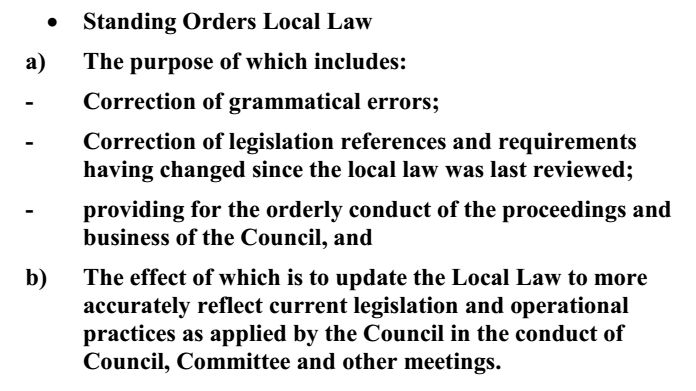
Council unanimously accepted this justification to increase penalties from $1,000 to $5,000 and to apply the higher penalty unilaterally to ALL Standing Orders - without discussion or debate in Council - i.e. all or any decisions to support these changes appear to have been previously made behind closed doors.
The Council (comprising only 11 Councillors of 14) which made the unanimous decision to approve these amendments is shown HERE.
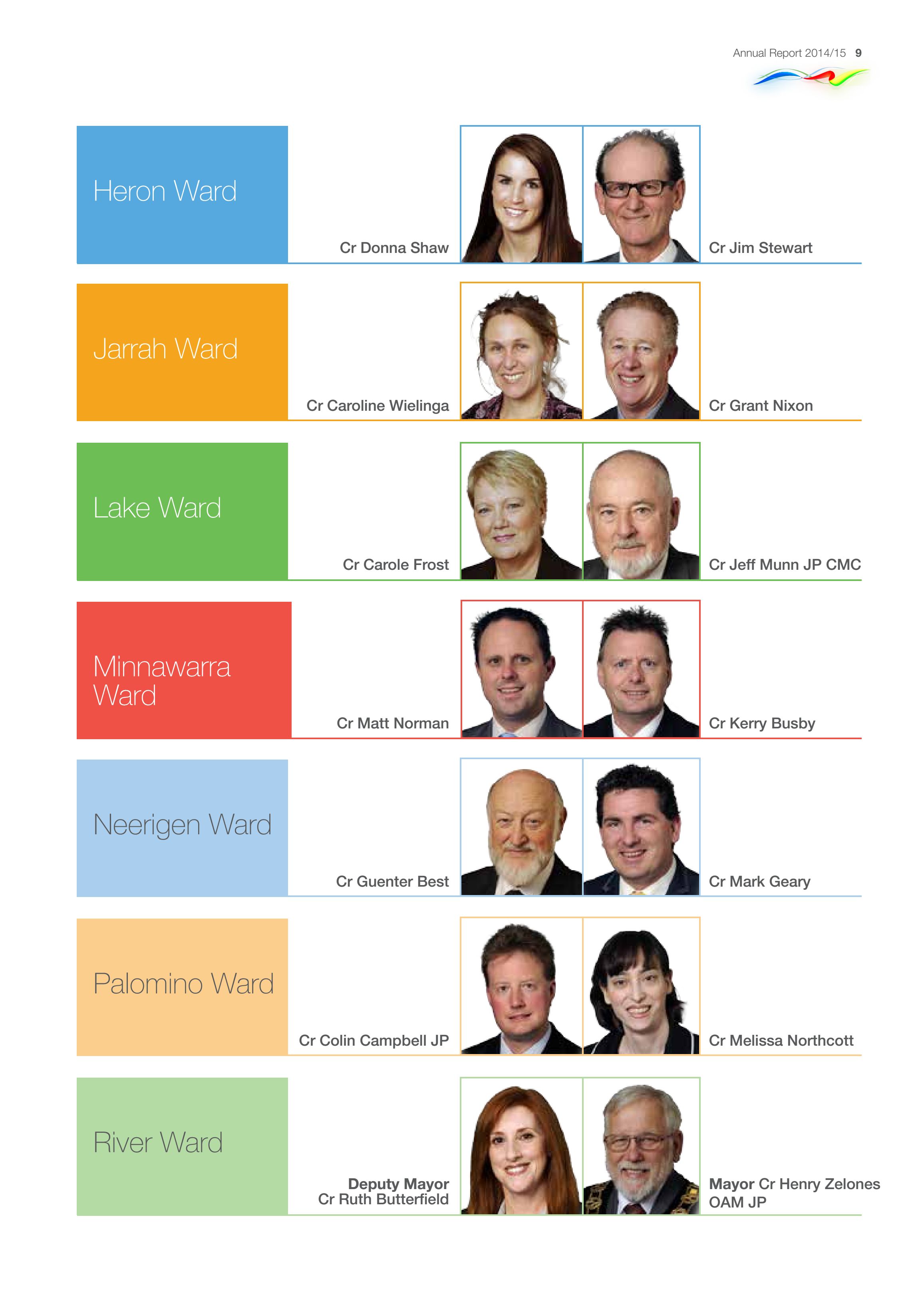
To remove doubt, Councillors present were:
Mayor, Cr
H A Zelones OAM JP River Ward
- presiding officer
Deputy
Mayor, Cr R Butterfield
River Ward
Cr J A
Stewart
Heron Ward
Cr D M
Shaw
Heron Ward
Cr G
Nixon
Jarrah Ward
Cr C M
Wielinga
Jarrah Ward
Cr C
Frost
Lake Ward
Cr J H Munn
JP
CMC
Lake Ward
Cr G A
Best
Neerigen Ward
Cr M Geary
Neerigen Ward
Cr C A
Campbell
JP
Palomino Ward
Cr K
Busby, Cr M H Norman and Cr M S Northcott were absent from this meeting.
However Mayor Zelones and Cr Busby were members of the City Strategy Committee 16 March 2015, which unanimously endorsed the amendments, which Council subsequently unanimously approved without amendment.
After considering the detailed changes and having regard to the 2012 City of Canning Enquiry Report and various published decisions from the Local Government Standards Panel, it was clear to this Elector that both the description and stated purposes were somewhat brief and lacking clarity.
The
object: "provide for the orderly
conduct of the proceedings and business of Council" can only be
described as spin and pure BS.
If
the object of the law is "ORDER" then banning of Councillors from
challenging bad proposals or decisions of the Executive, Committees or Council
can only be beyond that scope.
If
the object of the law is "ORDER" then banning of the Public from
asking questions relating to perceived to be bad proposals or decisions of the
Executive, Committees or Council can only be beyond that scope.
It was obvious the amendments would have the effect of muzzling Council by procedure and process, thereby making it a puppet of the Executive and Person Presiding - normally the Mayor, thereby stripping Council of its role as a democratically elected representative of the people.
Worse, the imposition of a $5,000 penalty upon Councillors, Executive Officers, Support Staff and Members of the Public, was totally over the top and worthy of the most despotic regimes in the world today.
Council later admitted in a later meeting that there has never been a prosecution for a breach of this law and never been a situation where the meeting became "out of order" - so why the heavy handed penalties when there was no rational justification ?
The answer is "because they can" !!
Following vigorous representations by this elector to Council and each Councillor individually, including the set of Public Questions put to Council on 13 July 2015 challenging the validity of the above and other matters, Council reconsidered and on 29 September 2015 referred the matter back to its Executive. This led to the matter being further investigated by the City with the relevant state authorities.
It is relevant
to this BAN that the official Notice advising me of the BAN was issued the same
day as the responses to these questions.
Of particular
interest is the CEO response – on behalf of Council – to Question 41 regarding
communicating with the City.
Council reacted badly to
these questions because the questions were designed to show that neither
Council nor its Executive had thought through the political and administrative
consequences of breaches to the Standing Orders, and the processes required to
prosecute for alleged breaches by both Councillors or Public.
Note "Public"
includes Residents, Ratepayers, Electors and any other person who might submit
a "Public Question" to Council or a Committee.
It is relevant that should
a person be issued with an Infringement Notice but chooses not to pay within
the prescribed time period, the matter automatically becomes a criminal matter
and the defendant thereby incurs a permanent criminal record – which is likely
to adversely affect that person for the remainder of their lives.
Given the sensitive egos
of some Councilors a prosecution would be very likely under these revised
Standing Orders.
That sensitivity might be
illustrated by the fact that the set of Public Questions put to Council
on 13 July 2015 and responses have never previously been made public –
notwithstanding Policy EM6 and
supporting Management
Practices EM6 prescribe that they should (thereby a breach of Council's
Code of Conduct).
Subsequently, Council decided that compliance with the statutory process for the making or amending of local laws, these draconian provisions were withdrawn.
On 21 December 2015, after further research and consultation with higher authorities, Council unanimously approved the revised Standing Orders as "final for Public Comment", as the first step in the gazettal process.
At that meeting Council
resolved to "….give local public notice of the proposed amendments……"
However this set of
Standing Orders had already been Gazetted
on 26 August 2016 – just one week after the
Ban upon me – but four months BEFORE Council
approved them for public information of "proposed" amendments.
Those revisions
became law fourteen days after Gazettal.
However, if we look deeper, we see that the Gazette declares the revised
Standing Orders were resolved by Council on 25 July 2016.
That is blatantly untrue because Council did not do that on that date.
As noted above, the revised Standing Orders were not resolved to be adopted
UNTIL 21 December 2015.
Surely this is
proof of the susceptibility of Council to manipulation.
It also suggest
that City of Armadale Local Law Standing Orders 2000 as Gazetted 26 August 2016
may be unlawful due to breach of due process. But if they were lawful
then they were in force from the end of September 2016.
If that is the case then Council is indeed the servant of its Executive.
Work that one out if you can !!
The December 2016 Council was a different entity to that which made the original amendments, because a biennial half-Council election had been held in October 2015.
The new Council (comprising only 10 Councillors of 14) which made the unanimous decision to approve these final amendments is shown HERE.
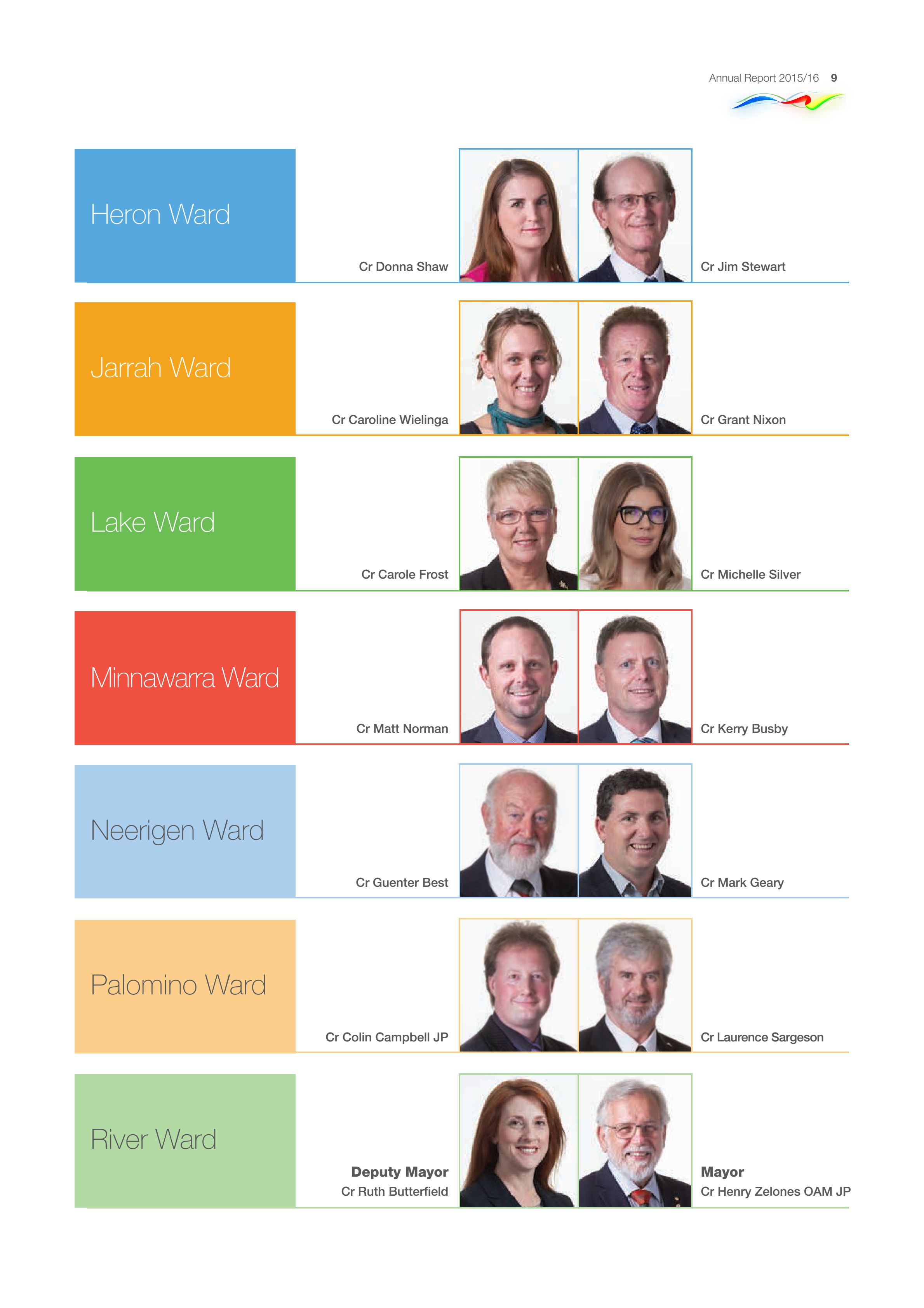
To remove doubt, Councillors present were:
Mayor, Cr H A Zelones OAM
JP
River Ward - presiding officer
Deputy Mayor, Cr R
Butterfield
River Ward
Cr J A
Stewart
Heron Ward
Cr G
Nixon
Jarrah Ward
Cr C M
Wielinga
Jarrah Ward
Cr C
Frost
Lake Ward
Cr M
Silver
Lake Ward
Cr G A Best
Neerigen Ward
Cr L
Sargeson
Palomino Ward
Cr C A Campbell
JP
Palomino Ward
Cr D M Shaw, Cr M Geary, Cr K Busby and Cr M H Norman were not present at
this meeting.
The result is City of Armadale Local Law Standing Orders 2000 as gazetted 26 August 2016– after two years in the making.
This major revision is designed to bring Standing Orders into line with the WA Local Government Association's model local laws but "consistent with advice received from the Department of Local Government and Communities (DLGC), and the Parliamentary Joint Standing Committee on Delegated Legislation (JSCDL)".
For details of changes see Minutes of City Strategy Committee 14 December 2015 – pages 15 to17.
The official gazetted version and CSC Minutes show only amendments, thus the only full version available is "as typed" "in-house" by the City.
However, consistent with
Council's propensity for deception, the current version is still shown as
"2000", with no reference to the latest gazetted amendments –
suggesting no amendments have
ever been made since their original publication in 2000 !!
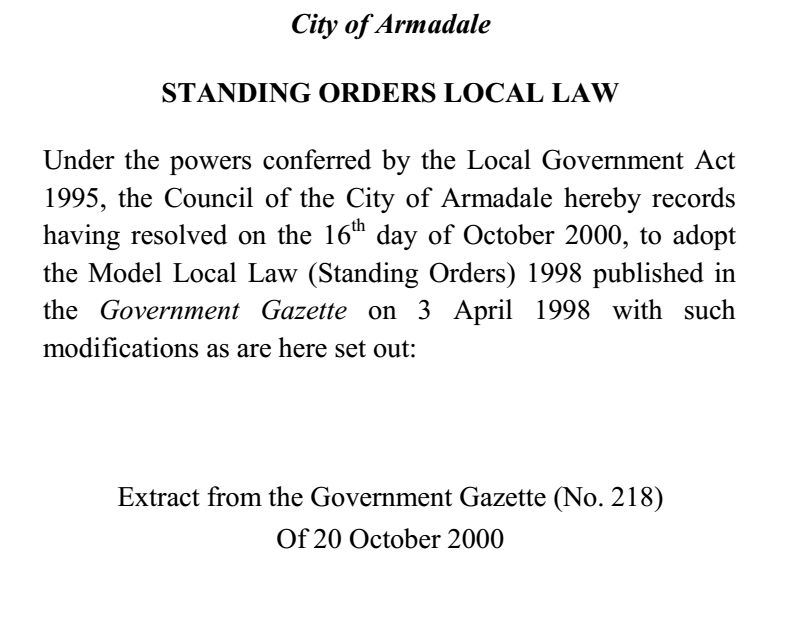
This is the preamble in the current version:
But hang on a moment !!
This is the latest revision of this law as resolved on 21 December 2015 and Gazetted 26 August 2016.
So where are those references and records of revisions to this law ?
But wait there is more !!!!
2016 Standing Order 1.4: Repeal states:
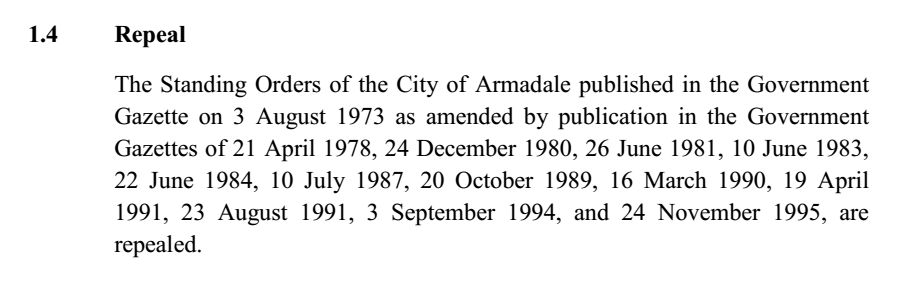
What happened to the versions of 2000 and 2016 ?
Regrettably, the City's
Local laws are not subjected to rigorous document control processes and several
different versions of Standing Orders have appeared on its
website over time – confusion
reigns !!
This is one of the products of assigning corporate document control to the typing pool.
But do not worry, the text is accurate (I hope).
If it is not accurate, "ignorance" is not a defence in law.
It is up to the Public to discover which version is the applicable one.
The preamble to the current versions states:
"Under
the powers conferred by the Local Government Act 1995, the Council of the City
of Armadale hereby records having resolved on the 16th day of October 2000, to
adopt the Model Local Law (Standing Orders) 1998 published in the Government
Gazette on 3 April 1998 with such modifications as are here set out:"
Extract
from the Government Gazette (No. 218) Of 20 October 2000"
No-one would ever know they have ever been modified in any way since 2000.
Not only that, but in no way does the text in the Government Gazette resemble the complete set of Standing Orders.
Is that honest, open and transparent local government ?
Is that "better" local government as required by the WA Constitution?
In Western Australia,
Local Laws are invalid unless created using the process prescribed by
Parliament and compliant with the following conditions as set out by
the Parliamentary Joint
Standing Committee on Delegated Legislation – as set out in Schedule 1 of the
Legislative Council Standing Orders.
3. Joint Standing Committee on Delegated Legislation
3.1 A Joint Standing Committee on Delegated Legislation is established.
3.2 The Committee consists of 8 Members, 4 of whom are appointed from each House. The Chairman must be a Member of the Committee who supports the Government.
3.3 A quorum is 4 Members of whom at least one is a Member of the Council and one a Member of the Assembly.
3.4 A report of the Committee is to be presented to each House by a Member of each House appointed for the purpose by the Committee.
3.5 Upon its publication, whether under section 41(1)(a) of the Interpretation Act 1984 or another written law, an instrument stands referred to the Committee for consideration.
3.6
In its consideration of an instrument, the Committee is to inquire whether the
instrument –
(a) is authorized or contemplated by the empowering
enactment;
(b) has an adverse effect on existing rights,
interests, or legitimate expectations beyond giving effect to a purpose
authorized or contemplated by the empowering enactment;
(c) ousts or modifies the rules of fairness;
(d) deprives a person aggrieved by a decision of
the ability to obtain review of the merits of that decision or seek judicial review;
(e) imposes terms and conditions regulating any review that
would be likely to cause the review to be illusory or impracticable; or
(f) contains provisions that, for any reason, would be more
appropriately contained in an Act.
3.7 In this clause –
“adverse effect”
includes abrogation, deprivation, extinguishment, diminution, and a compulsory
acquisition, transfer, or assignment;
“instrument” means -
(a) subsidiary legislation in the form in which, and with the content it has, when it is published;
(b) an instrument, not being subsidiary legislation, that is made subject to disallowance by either House under a written law;
“subsidiary legislation” has the meaning given to it by section 5 of the Interpretation Act 1984.
Notwithstanding 3.6 (b) and (c) the revised Standing Orders were approved and gazetted.
Note: The determination by the Department of Local Government confirming the legitimacy of the ban - i.e. absolute powers of the Person presiding - under Regulations breaches 3.6 (d).
If order, uniformity and consistency are all that are
needed, then Standing Orders could be simple and straightforward.
However that is not the case because they have been designed to CONTROL Council – more specifically, individual Councillors.
There are 14 Councillors and each is required to conform to the Standing Orders.
One of the key control mechanisms is the AGENDA.
This is prepared by the CEO and by law must be provided to Councillors and the public at least 72 hours prior to a meeting of Council or a Committee.
City of Armadale Local Law Standing Orders 2000 - Standing Order 3.1 prescribes:
3.1 Business to be Specified on Notice Paper
(1) No business, other than that specified in the agenda, is to be transacted at any ordinary meeting of the Council without the approval of the person presiding or a decision of the Council.
(2) No business is to be transacted at a special meeting of the Council other than that given in the notice as the purpose of the meeting.
(3) No business, other than that specified in the agenda, is to be transacted at a committee meeting or given in the notice as the purpose of the meeting, without the approval of the Presiding Member or a decision of the committee.
(4)
No business is to be transacted at an adjourned meeting of the Council or a
committee other than that –
(a)
specified in the notice of the meeting which had been adjourned; and
(b)
which remains unresolved;
except in the case of an adjournment to the next ordinary meeting of the
Council or the committee, when the business unresolved at the adjourned meeting
is to have precedence at that ordinary meeting.
Thus by virtue of LAW, the AGENDA ensures no other business is brought before the meeting.
Although Standing Order
3.1 provides for "approval of the person presiding, or Council or
Committee", there is NO provision in Standing Orders for a Member to
submit an extra item for
discussion without notice – UNLESS it is a matter of "EXTREME
URGENCY" or "other special circumstance".
3.10 Urgent Business Approved By the Person Presiding or by Decision
(1) Subject to subclauses (2) and (3), in cases of extreme urgency or other special circumstance, matters may, with the consent of the person presiding, or by decision of the members present, be raised without notice and decided by the meeting.
(2) Before a matter may be raised under subclause (1) the person presiding or a member otherwise seeking to raise the matter is to state why the matter is considered to be of extreme urgency or other special circumstance.
(3) If a member of the council or committee as the case requires, objects to a matter being raised without notice, any decision of the council or committee in regard to that matter does not have effect unless it has been made by an absolute majority.
Clearly, the Member must gain the support of the person presiding AND/or Council by majority vote – a formidable hurdle when the meeting is designed to be controlled and suppress dissent.
Then there is the pathway of a "grievance issue".
3.12 Grievance Issue
Notwithstanding anything contrary in these Standing Orders, a member of the Council who feels aggrieved by anything, which may have transpired since the last ordinary meeting of the Council, and relating to the good government of persons in the district, may raise that issue; provided that a member first seeks the advice of the person presiding and, provided that the issue does not relate to an employee of Council.
Again, the person presiding is the barrier/filter and may decline to allow the matter to be raised via his or her absolute discretion.
Note also Standing Order 8.4
8.4 Adverse Reflection
(1) No member of the Council or a committee is to reflect adversely upon a decision of the Council or committee except on a motion that the decision be revoked or changed.
(2) No
member of the Council, or a committee, or member
of the public is to use offensive orobjectionable expressions in
reference to any member, employee of the Council, or any other person.
Penalty $1,000
(3) No member of the Council, or a committee, or member of the public is to reflect adversely on the character or ACTIONS of a member, officer or any other person participating in the meeting.
Thus a Councillor aggrieved by something full Council, a full Committee, or a Councillor or an officer may have said, done or not done, is prohibited BY LAW from criticising or challenging that during a meeting.
Note: “adverse effect” is defined above to include abrogation, deprivation, extinguishment, diminution, and a compulsory acquisition, transfer, or assignment;
Note: There is no time limit on this Standing Order, which means critique is banned in perpetuity.
Note: It remains to be seen if Local Law Standing Orders 2000 applies retrospectively, insofaras the requirement prohibiting "speaking adversely" about the "ACTIONS of a member, officer or any other person participating in the meeting" applies outside of the relevant meeting. i.e. once a meeting is concluded does the local law still have effect ?
City of Armadale Policy EM12 declares:
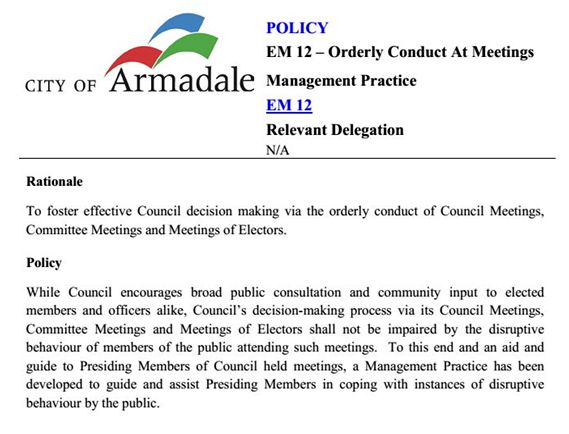
Think about what this policy says.
It is focused on
"disruptive behaviour" – a characteristic not usual in the City's
experience. - so is a "just-in-case" policy.
"Management Practice EM12" procedure commences with these noble words :
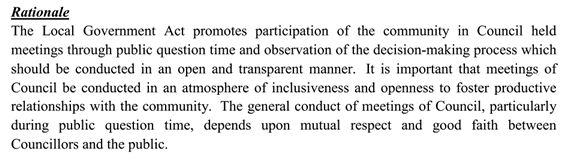
However the detailed "Management Practice EM12" procedure concerns itself ONLY with "disruptive behaviour".
In the case of the OBJECTS of the rationale, there is absolutely nothing in EM12 Policy or Management Practice to give effect to those objects.
This policy clearly limits "participation of the community" to "public question time" and "observation".
In the mind of Council watching a movie on TV is the same as being in it !!
As to how this "fosters productive relationships with the community" remains a mystery.
Do I develop a productive relationship with my TV because I watch it ?
The policy itself says absolutely nothing because the "Management Practice EM12" referred to merely provides guidelines to the Person presiding who, as we have seen previously, has absolute discretional power to decide whatever he or she wants.
But what about Standing Orders ?
Are they not supposed to set out a law for "effective Council decision making via the orderly conduct of Council Meetings, Committee Meetings and Meetings of Electors" ?
But look deeper – the above Policy EM12 actually refers only to "disruptive behaviour by the public" – i.e. Councillors are exempt from it even though it is they who are holding the meeting.
Again, the focus of procedural regulation is to control and suppress the public.
Now if all of the above
does not move you, consider the most recent attempts in Council to further
suppress the public voice with further barriers and procedural
restrictions.
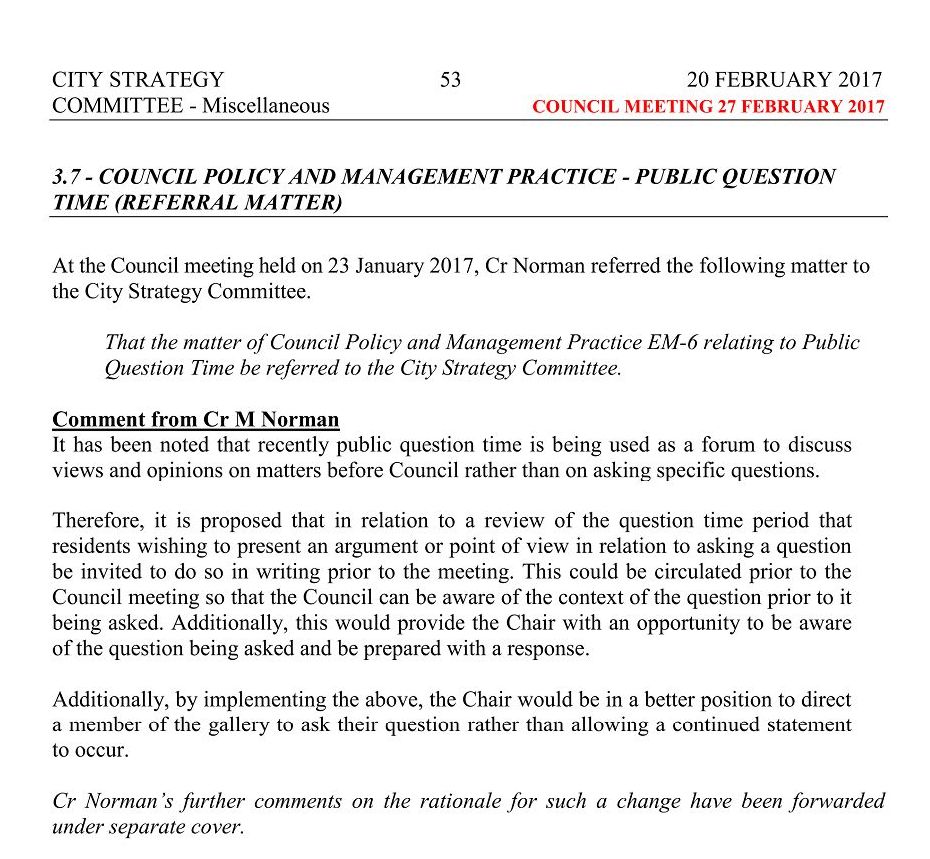
On the face of it the above Committee business might seem reasonable and rational.
But have another look at the BAN and the claimed legal basis for it.
The Minister for Local Government and his Department of Local Government, the Mayor of the City of Armadale and CEO of the City of Armadale, supported by their Council, have all claimed that the Person Presiding has ABSOLUTE power to determine not only Procedures for meetings (Standing Orders) but "MATTERS" before a meeting.
Yet here we have a Committee of Council in 2017 discussing how they might impose even further restrictions on an ignorant public.
The ethos of our esteemed Council is that orderly meetings are more important than sound decision making and that the public have no place in the elevated echelons of the local government.The public is permitted to only observe and listen to the theatre of meetings. Participation is not only banned but there is no provision in City of Armadale Local Law Standing Orders 2000 or any Policy, for the Person presiding to allow a Member of the Public to address Council - regardless of the importance of any issue or matter to the community.
i.e. "process" for "governance" is the dominant rule.
Don't believe that ?
Council has been requested many times since 2000 to introduce a "Public Statement Time" into its Committee and Council meetings – but in every case has declined.
A "Public Statement Time" would assist Council to give effect to the OBJECTS expressed in its "Management Practice EM12".
However the risk of the public airing grievances or constructive recommendations in the public arena fills the Council with fear of losing its absolute control as well as fear of exposure of some of its covert decision making and actions.
In contrast, progressive
local governments, including the neighboring Shire of Serpentine-Jarrahdale,
have included a Public Statement Time without the sky falling in.
********************************************************************************************************************************************************************************************************
For an independent opinion
on all of this saga see the article "Function of Council Key to Better
Services" as published in the West Australian July 05-06
2014.
Note: The
pdf file has two pages - use your browser to scroll to the second page
This article was published
at about the same time as the City of Armadale embarked on its review of Local
Law Standing Orders 2000 in 2014.
The thrust of the article
is to highlight the propensity of Councils to preserve the status-quo.
As can be now seen by its
diligent actions in its review of the local law, preserving the status-quo is not only a priority but the end goal
in itself.
During the period of
governance under the leadership of Mayors Stubbs, Reynolds and Zelones and CEO
Tame, the Council of the City of Armadale has religiously voted unanimously on
almost all matters before it.
However that demonstrable
fact should not be construed as implying anything at all other than "orderly management" consistent
with Standing Orders – which is law.